AI has become one of the defining forces reshaping how marketing teams operate, from the way campaigns are planned to how content actually gets made. What started as a handful of experimental tools a few years ago has turned into a core part of how marketing decisions get made day to day.
That shift is visible in the numbers. Grand View Research projects the AI in marketing market to grow from USD 35.0 billion in 2026 to USD 82.2 billion by 2030, a CAGR of 25.0%, a pace matched by few other segments in the industry today. HubSpot's research reinforces this from the ground level: 61% of marketers say this represents the biggest shift they have witnessed in the field in 20 years, and 80% are already using AI for content creation, with 75% using it for media production
What is AI in Marketing?
At its core, AI in marketing means handing data analysis, content generation, and a lot of routine decisions over to machine intelligence instead of doing them by hand. It touches research, creative work, targeting, optimization, basically every stage where marketers used to rely on gut instinct or slow manual testing.
Why AI is Transforming Modern Marketing
Customers changed faster than most marketing playbooks could keep up with. People now bounce across more channels before buying than they ever did a decade ago, and a growing chunk of that research happens through AI-powered search rather than a traditional Google query.
That leaves brands needing to show up consistently across a much wider footprint than before. The old campaign rhythm, plan, launch, wait weeks for results, just doesn't match how people actually decide anymore.
How AI Works in the Marketing Lifecycle
AI is not confined to one team or one task. It runs through the whole lifecycle:
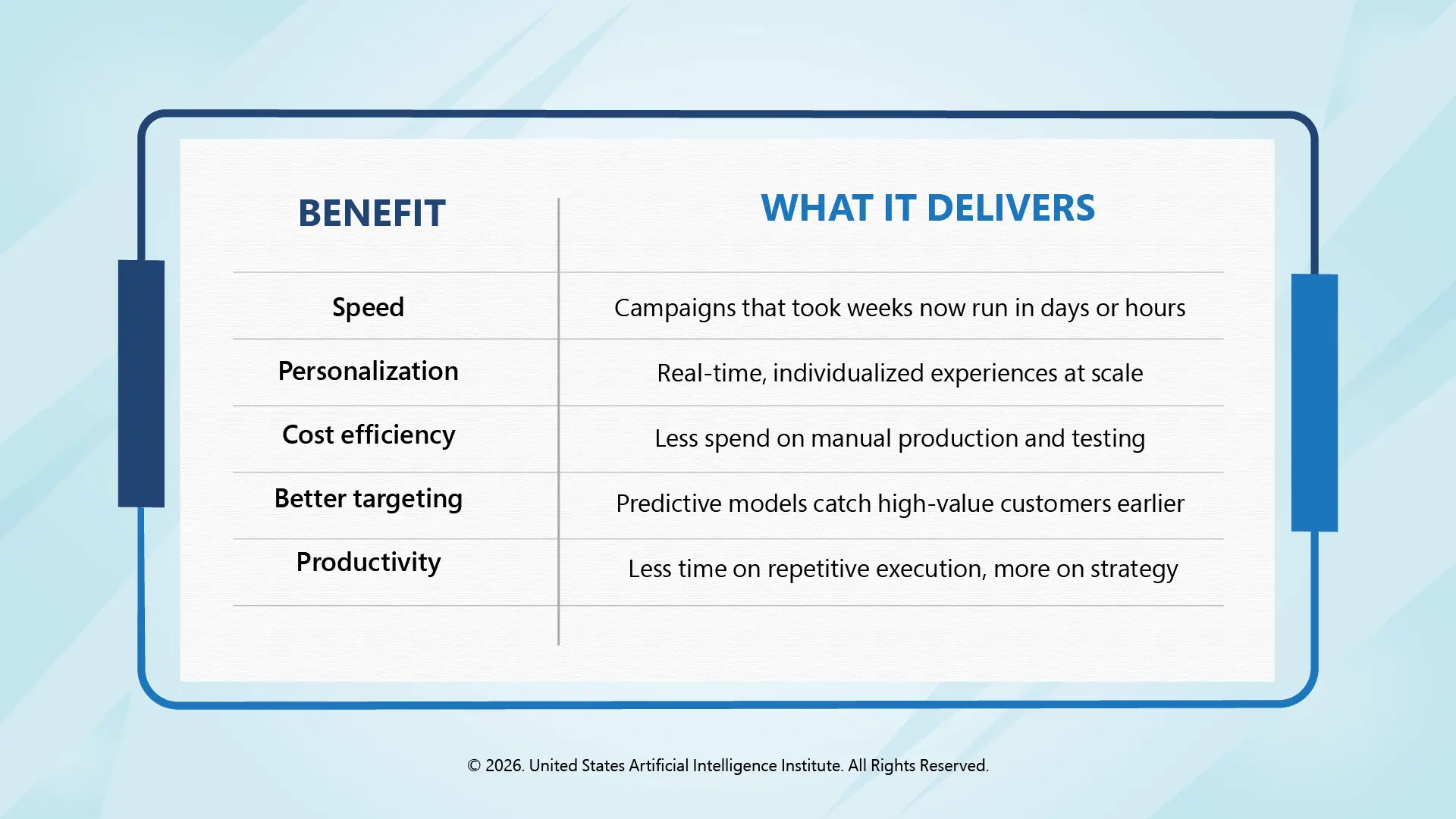
Key Benefits of Artificial Intelligence in Marketing
The payoff goes well past speed. It changes cost structure, targeting accuracy, and how teams actually spend their working hours.
Common AI Technologies Used in Marketing
A handful of core technologies do most of the work, each suited to a different kind of task.
Top AI Use Cases in Marketing
These AI marketing tools/technologies now show up in nearly every marketing function, from writing copy to handling customer support, and adoption keeps climbing.
Career Opportunities in AI Marketing
As these capabilities scale, marketing teams need people who can blend real strategic judgment with technical AI fluency, roles that barely existed a few years back. This is not just changing daily workflows; it is changing job descriptions outright.
New titles like AI Marketing Manager, Marketing Machine Learning Engineer, Prompt Engineer, and AI-Powered Content Strategist are showing up in job postings at a pace that didn't exist even two years ago.
A few signals worth noting:
That pay reflects how much of a premium employer are willing to put on marketers who can actually work with AI systems, not just talk about them.
For anyone considering this shift, USAII's guide on how to transition into an AI career lays out the practical steps for marketers moving into AI-driven roles. USAII's AI certifications help formalize that expertise, giving marketing professionals a real way to prove credibility as AI stops being a side skill and becomes core to the job.
Conclusion
AI in marketing is not optional anymore. It is turning into the operating layer under nearly every marketing function, content, targeting, and customer service, and budgets are already moving to match that reality.
For marketers, the real opportunity is building both practical AI fluency with these tools and the judgment to actually apply them well. That combination is fast becoming the baseline for the job, not a specialty reserved for a few people on the team.
Part 2 of this blog digs into what comes next: AI governance, ethical considerations, and where AI marketing strategy is headed as these tools mature.
FAQs
Does using AI in marketing require a technical background?
Not really. Most AI marketing tools run on no-code interfaces, though knowing how the tech works underneath helps you use them better.
How is AI changing marketing team structures?
Teams are shifting toward hybrid roles that mix strategic marketing judgment with hands-on AI tool management.
Is AI in marketing expensive to adopt for small businesses?
No. Plenty of AI marketing tools offer free or low-cost tiers, so smaller teams get real capability without enterprise-level spending