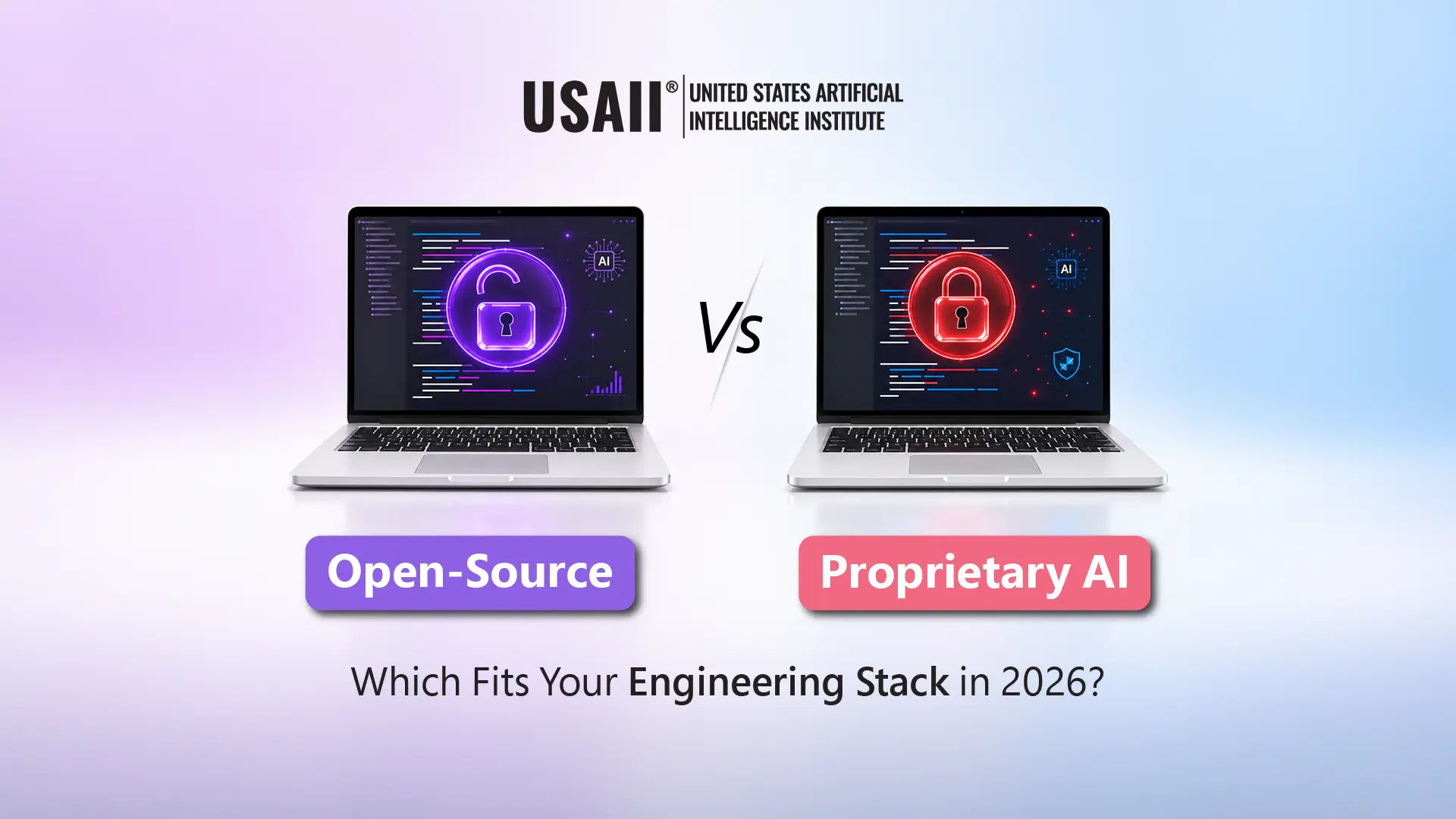
In 2026, AI engineers are choosing between open-source and proprietary AI models based on more than benchmark scores. Cost, customization, data privacy, and deployment flexibility have moved to the center of the decision. According to Reuters, open-source AI models now process 65% of all AI tokens on OpenRouter, reflecting a meaningful shift as developers favor models like Llama 4 and DeepSeek for production workloads where cost and control matter as much as capability.
The right choice between open-source and proprietary AI models depends less on which is objectively better and more on what the project actually demands. This blog compares both across the factors that matter most to engineering teams in 2026.
What Are Open-Source AI Models?
Open-source LLMs are models whose weights are publicly available, allowing teams to download, run, fine-tune, and deploy them on their own infrastructure. The organization controls the deployment, the data, and the model behavior.
Leading open-source models in 2026:
Available in multiple sizes from 17B to 400B+ parameters. Permits commercial use for applications under 700 million monthly active users under the Meta Community License.
Targets frontier-class performance under a custom commercial license that includes restrictions on specific competitive use cases.
Competitive on coding and math benchmarks. Carries a non-standard license that requires review before commercial deployment.
MIT-licensed with 76.8% on SWE-bench and 99.0% on HumanEval, one of the strongest open models for coding in 2026.
What Are Proprietary AI Models?
Proprietary AI models are owned and operated by vendors who control the weights, training data, infrastructure, and distribution. Access is provided through APIs or managed platforms, with engineering teams paying per token or through subscription tiers.
Leading proprietary models in 2026:
GPT-5.5 Instant became ChatGPT's default in May 2026, posting 52.5% fewer hallucinated claims on high-stakes prompts. GPT-5.5 Pro handles complex agentic tasks.
Built for advanced reasoning and long-horizon agentic work with a 1M token context window. Fable 5 is generally available. Mythos 5 carries the same underlying capability but remains restricted to vetted partners due to its advanced capabilities in cybersecurity.
Read the detailed USAII® insight on Claude Fable 5 and Mythos 5: Anthropic's Most Advanced AI Systems. A detailed breakdown of what is new in both models, how they compare, and what this release means for AI professionals in 2026.
Gemini 3.5 Flash runs four times faster than other frontier models and is built for agentic tasks. Gemini Omni handles multimodal creation across image, audio, video, and text.
Enterprise-grade deployment of OpenAI models wrapped with Microsoft compliance and governance frameworks.
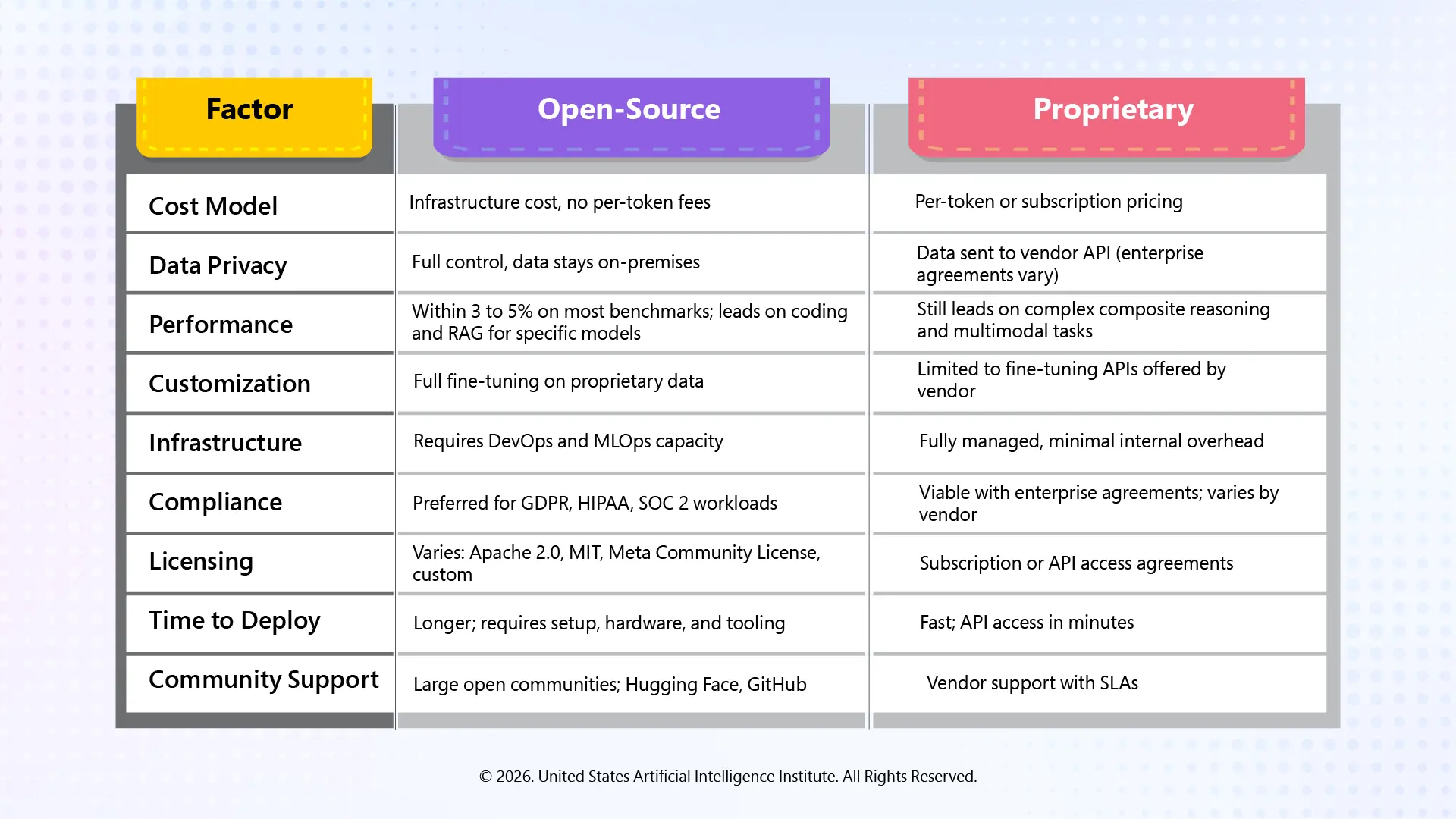
Open-Source vs Proprietary AI Models: Head-to-Head Comparison
The right model strategy depends on a specific combination of cost, control, compliance, and capability requirements.
Listed below is a direct comparison across the factors that matter most to engineering teams in 2026.
When to Choose Open-Source Models
Open-source is the stronger fit when one or more of the following apply:
When to Choose Proprietary Models
Proprietary LLMs are the stronger fit when:
Why Most Teams Use Hybrid Approach
The most successful engineering teams in 2026 do not pick a side. They route requests across both model types based on what each task actually demands.
The pattern that consistently wins:
If you are evaluating AI tools for your engineering stack, Codex vs Cursor: The Two Faces of AI-Assisted Coding USAII® insights cover how both fit into a modern development workflow.
Upskill with USAII® CAIE™ Certification
The decision between open-source and proprietary models is only half the equation. Building the capability to implement, fine-tune, deploy, and govern either one in production is what separates AI engineers who advise from those who actually ship.
USAII® Certified Artificial Intelligence Engineer (CAIE™) covers exactly this depth from LLM architecture, RAG pipelines, MLOps, generative AI, and NLP to responsible AI deployment, built for professionals ready to work with both open-source and proprietary models at the engineering level.
Start building that expertise today.
FAQs
Is open-source AI always cheaper than proprietary?
Not below 10 million tokens per day, infrastructure and engineering overhead often make proprietary APIs more cost-effective at lower volumes.
Can open-source models match GPT-4o in 2026?
On specific tasks like coding and RAG, yes. On complex composite reasoning and multimodal tasks, proprietary models still hold an edge.
What is the biggest reason teams choose open-source over proprietary? D
Data privacy. For regulated industries, keeping data on-premises is often a compliance requirement, not a preference.