
By Elizabeth Enyart Allen, Principal Consultant - Enyart-Allen LLC, United States

AI isn't just an experiment in modern healthcare; it's become the foundation for how we deliver care. But as leaders, the main challenge isn't evaluating isolated model performance. It's mastering clinical execution at scale. We see a clear gap today between AI investment and operational maturity. CAITL data shows 92% of healthcare orgs are scaling AI investments, but only 1% consider themselves mature in deployment. That gap traps great ideas in "pilot purgatory."
The Trap of "Pilot Purgatory"
Pilot purgatory is what happens when an organization brings in AI and pilots begin all over the company with no clear, coordinated adoption plan. Instead of driving business transformation, the pilots become isolated technology trials that demonstrate technical feasibility in a sandbox but completely fail to scale enterprise-wide or deliver measurable Return on Investment (ROI).
The Hidden Engine: "Shadow AI"
This occurs because of a major workforce gap. About 50% of healthcare staff use AI tools today, but only 16% have formal training. This is referenced in CAITL data with examples from Microsoft, LinkedIn, Salesforce, and Slack. This “Shadow AI” phenomenon where employee adoption outpaces corporate training infrastructure. This drives a massive "Shadow AI" surge.
Employees start using unauthorized, personal AI accounts to cut through administrative drag because official enterprise tools are too clunky or gated. When half your team uses probabilistic systems without training in a deterministic clinical setting, things break.
To fix both “Shadow AI” and “Pilot Purgatory”, leaders must focus on the orchestration layer. But as clinical architects point out, an orchestration layer only becomes defensible when it governs meaning, authority, and clinical context; not when it merely routes API traffic. Building a secure, Sovereign AI setup to keep patient data local and compliant is our best competitive moat for the next decade. But that only works if we fix our fragmented data architectures first.
Data readiness is the bedrock of AI maturity.
When patient data sits locked in legacy Electronic Health Record (EHR) silos, we have to re-engineer our pipelines toward standardized, real-time FHIR and HL7 data streams.
Recent milestones like OpenAI and Epic bringing ChatGPT into EHR environments are great for time-to-insight. But FHIR only transports context; the health system still needs versioned terminology, policy logic, strict access boundaries, data provenance, and clear escalation rules.
Moving from read-only search to active clinical support brings real platform hurdles:
To orchestrate end-to-end care, leadership needs to align with the 4 Pillars of Next-Gen AI:
Fixing these pipelines lets us move through the 4-Pillar Data Model (Descriptive, Diagnostic, Predictive, and Prescriptive). The goal is simple: drop clinical cognitive load. Delivering clear, prescriptive steps into native workflows turns AI from a side dashboard into a real co-pilot.
Zero Trust Clinical Governance
In healthcare, managing "invisible risks" (like hallucinations, model drift, and stale data context) is a daily requirement. Since AI is probabilistic, fixed security rules don't work.
We need a Zero Trust Clinical Framework:
Governance shouldn't slow down team execution. We treat "Compliance-as-Code" inside our DevSecOps setup. Automated audit trails and RAG-based tracing satisfy HIPAA, GDPR, and EU AI Act requirements out of the box. That lets teams iterate fast while keeping human oversight as the final authority.
Healthcare AI exists to absorb administrative drag and fight clinician burnout. Keeping Human-in-the-Loop (HITL) guardrails is essential. Physicians must keep full authority to override any algorithmic suggestion, especially for high-risk diagnostic or treatment decisions.
While hitting financial benchmarks like $3.70 ROI for every $1 spent is critical for the C-suite, scaling AI without clinical safety metrics creates massive institutional risk. We must measure model performance alongside bedside workflow safety:
Here is the side-by-side metric comparison:
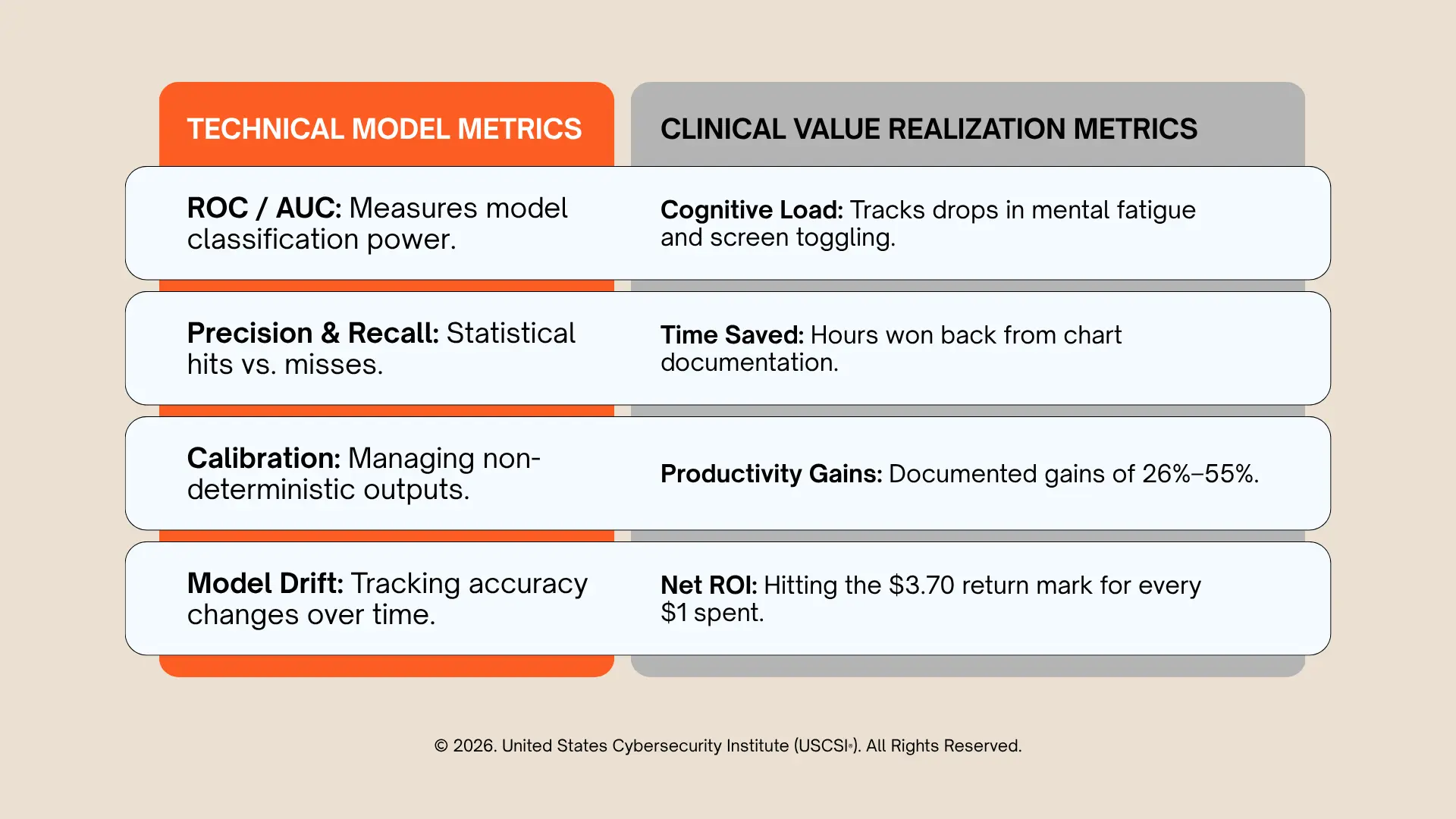
Tracking time saved, clinical safety endpoints, and burnout reduction gives leadership the clear business case needed to expand pilots into enterprise platforms.
Conclusion & Leadership Checklist
Bridging the execution chasm is our primary focus in modern healthcare product leadership. Winning systems won't just hold the most data. They will run the most trusted, defensible orchestration layers.
Closing the capability gap takes balancing product agility with strict Sovereign and Agentic AI controls.
To drive progress this quarter, product and executive leaders should focus on three steps:
The future of healthcare comes down to human-AI collaboration. By moving beyond passive chart summarization to master native workflow orchestration, healthcare leaders can finally defeat pilot purgatory, eliminate shadow AI risks, and deliver a secure, human-centered future for patient care.