By Chris Solie, Vice President Finance - PMI Augusta Aiken Chapter (Freelance), United States

On November 1, 2025, I officially retired from the United States Space Force. When you leave the military after a long career, there is a well-worn playbook handed to you. It involves translating military jargon into corporate speak, highlighting your leadership span of control, and finding a "safe landing" in a role that looks remarkably like your last one, just with better pay and no uniform.
For my part, I initially followed the playbook. I leveraged my MBA in HR Management. I earned my PMP. I secured my Agile certifications (PSM I, PAL I) and kept my CompTIA Security+ current. I spent months having conversations with transition coaches and recruiters, applying to job boards, and attending recruitment fairs. The path seemed clear: Step into a Senior Program Manager role, build Gantt charts, manage human capital, and keep the slides "Green."
The False Comfort of Deterministic Success
I felt confident in this path because I had a track record of managing complex technical transformations. In the Army, serving in high-tempo environments like Iraq and Korea, I was directly responsible for implementing IT infrastructure retrograde projects. I oversaw the copper-to-fiber transformation of a main distribution frame and the installation of the Modernized Enterprise Terminal (MET) for tactical and strategic satellite hubs.
Later, as a Senior Development Manager with the U.S. Space Force, I directed a 30-member working group to design and implement a five-year leadership development strategy, securing
$30M in funding and integrating 56 specific course outcomes.
These projects were massive, complex, and high stakes, yet deterministic.
I walked into the civilian job market assuming AI Project Management would follow these same rules. I believed I could manage an AI model rollout the same way I handled a copper-to-fiber switch: set the requirements, hire the engineers, and track the completion date.
I was wrong.
The AI Reality Check
The disconnect hit me during a pivotal interview for an AI Project Manager position with a mature Program Management Office (PMO). On paper, my resume, loaded with the $30M strategies and enterprise IT overhauls, made me the perfect candidate.
But within minutes, the interview hit a wall. The interest wasn’t my ability to secure funding or manage a Gantt chart. They wanted someone who understood the Software Development Life Cycle (SDLC) in detail. They drilled down into deployment pipelines, version control, and the specific mechanics of how code moves from staging to production.
I didn't get the job, and honestly, that rejection was a gift. It exposed a critical gap that no amount of "senior leadership experience" could bridge. It proved that, in the AI era, the deterministic rules of IT infrastructure no longer apply. You cannot manage the lifecycle if you don't understand the engine room of the AI ecosystem.
In traditional IT, if a system fails, it’s usually a bug or a broken cable. In AI, if a system fails, it might just be a matter of probability. Managing "probability" requires a different skill set than managing "hardware." I realized that if I took the "safe" path, I would be a manager who knew the acronyms but couldn't diagnose the engine. So, I made a command decision: I wouldn't just be an "AI Manager." My path would be to become a Strategic Technologist.
The Certification Ladder: Building the Theory
A Strategic Technologist is a professional who aligns technology with an organization's long-term business goals to drive innovation and efficiency. They combine technical expertise with strategic vision. To build this profile, I had to layer my education:
The Strategic Technologist in Action: Validating Architecture
The theory was in place. But as I learned from my Army days, you don't really know the equipment until you've had your hands on it in the field. AI doesn't live on a certificate; it lives in libraries. I realized that to lead effectively, I needed Technical Fluency. That’s when I committed to establishing "Learning Laboratories" to audit the technology myself.
Lab 1: The "Dirty Data" Reality (Custom PDF OCR) My first mission was to architect a custom Optical Character Recognition (OCR) pipeline. As a traditional PM, I would have written a requirement: "Ingest PDF and output clean text." I assumed data was data, just like copper wire is copper wire.

By building the stack myself using Python, I learned that pytesseract isn't magic; you need pdf2image to convert the source and powerful Regular Expressions (re.sub) to strip the noise. I spent hours wrestling with "dirty data." I learned that data cleansing isn't just about deleting empty rows; it is about programmatic structure. When I output the final Excel file, I realized that owning the flow, the logic of how data moves, is the only way to guarantee integrity. Now, when a data scientist tells me “The preprocessing pipeline is broken,” I know they aren't making excuses. I understand the friction.
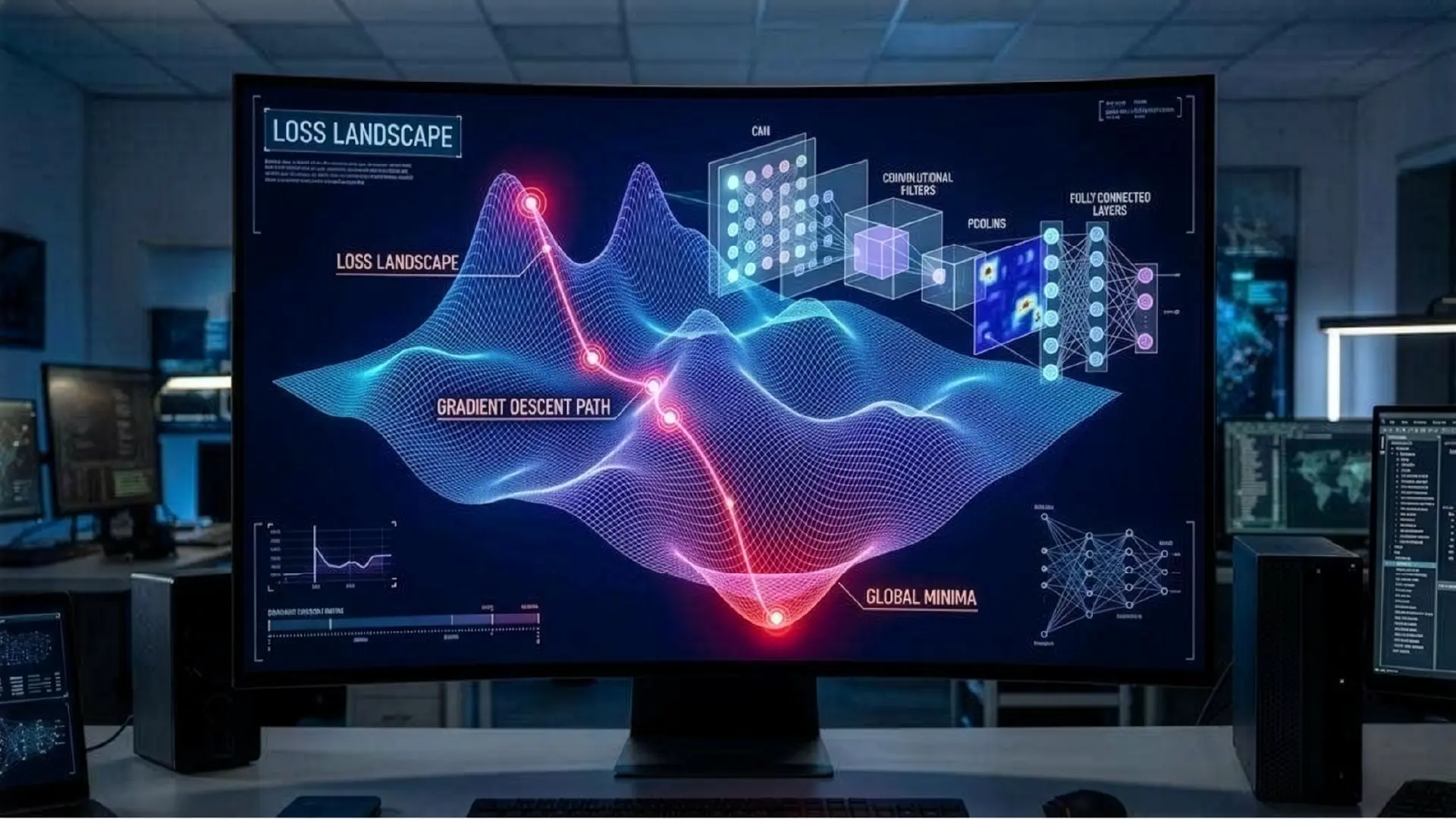
Lab 2: The Math Behind the Curtain (CNNs & Gradient Descent) Prompts don't define real-world AI projects; model fit defines them. To understand this, I stepped away from text models and dove into the architecture of a Convolutional Neural Network (CNN).
I didn't just run a script; I watched the loss functions converge. I studied the logic of gradient descent. Seeing how a CNN struggles to optimize its filters without sufficient data points taught me more about "Project Risk" than any risk register ever could. If you don't understand the shape of your data and the specific algorithm needed to process it, you cannot predict the timeline of your model's training.
Lab 3: The Strategic Architecture (Serverless & Scale) My final experiment involved acting as a Technical Architect for a friend’s media channel, building a "Gap Detector" agent using the YouTube Data API.
During our initial analysis, my instinct, honed by years of on-premises IT installations, was to build a functional model locally. However, research revealed this "local-first" approach was a strategic error. I pivoted to Cloud Resources, specifically utilizing Google Colab. The benefit was twofold:
This is directly connected to my digital transformation work at BufferSprings, where we used Zoho-based workflows to ensure strict governance. The lesson was clear: The future of AI isn't just about the most innovative model; it's about the most resilient, scalable infrastructure that sleeps until it's needed ("Scale to Zero").

The Strategic Imperative
The era of managing Artificial Intelligence as a "black box" is over. As organizations move from experimental pilots to enterprise-scale AI deployment, the traditional separation between "Business Strategy" and "Technical Execution" is becoming a liability.
My journey from the Space Force to the code editor has not been about becoming a software engineer; it has been about closing the governance gap. I discovered that the critical risks in AI projects, data drift, model hallucinations, and architectural scalability, cannot be managed solely through status reports or by securing funding. They must be managed through a fundamental understanding of the underlying mechanics.
The Strategic Technologist is not a unicorn. It is a necessary adaptation. For me, it represents a new class of Project Manager who combines the rigor of the PMP, the business savvy of an MBA, and the discipline of military service with the curiosity to audit the code. As we look toward 2026, the most effective leaders will not be those who demand results from AI, but those who possess the technical literacy to guide how those results are achieved. The user manual has changed; our management frameworks must evolve to keep pace with the artificial intelligence ecosystem.