The structure of professional technology work has undergone a fundamental transformation. According to the 2026 State of AI Development Report by OutSystems, 96% of enterprises are already using AI agents in some capacity, and 97% are actively exploring system-wide agentic AI strategies, marking a definitive shift from pilots to production.
Yet governance is struggling to keep pace: the Agents in Production: The Builder's Perspective report by Monte Carlo, 2026, surveying 260 enterprise leaders and engineers, found that 64% of organisations deployed AI agents before feeling fully prepared, a figure that rises to 75% among the software developers and engineers most directly responsible for keeping those systems operational. These are not cautionary projections. They are present-day operational realities. The professional entering this environment without a command of AI agent management will be at risk of staying ahead in the competitive AI job market.
The Question Is Not About Replacement, It Is Evolution
A prevalent concern among technology professionals is whether autonomous agents will displace human roles entirely. United States Artificial Intelligence Institute (USAII®), in its insight Will AI Transformation Replace or Evolve Jobs?, takes a clear position on this: the evidence supports role evolution, not elimination. Human professionals are being repositioned as directors, evaluators, and governors of AI-driven processes rather than sole executors of them.
This reframing is consequential. It shifts the professional challenge from one of survival to one of deliberate preparation, and that preparation begins with AI agent management.
What Is AI Agent Management?
AI agent management is the ongoing discipline of directing, monitoring, and governing autonomous AI systems within professional environments.
Unlike an AI chatbot that follows a fixed script, an AI agent reasons through complex objectives, accesses external tools and data independently, and executes multi-step tasks without human intervention at each stage, making continuous supervision, not one-time configuration, the defining responsibility.
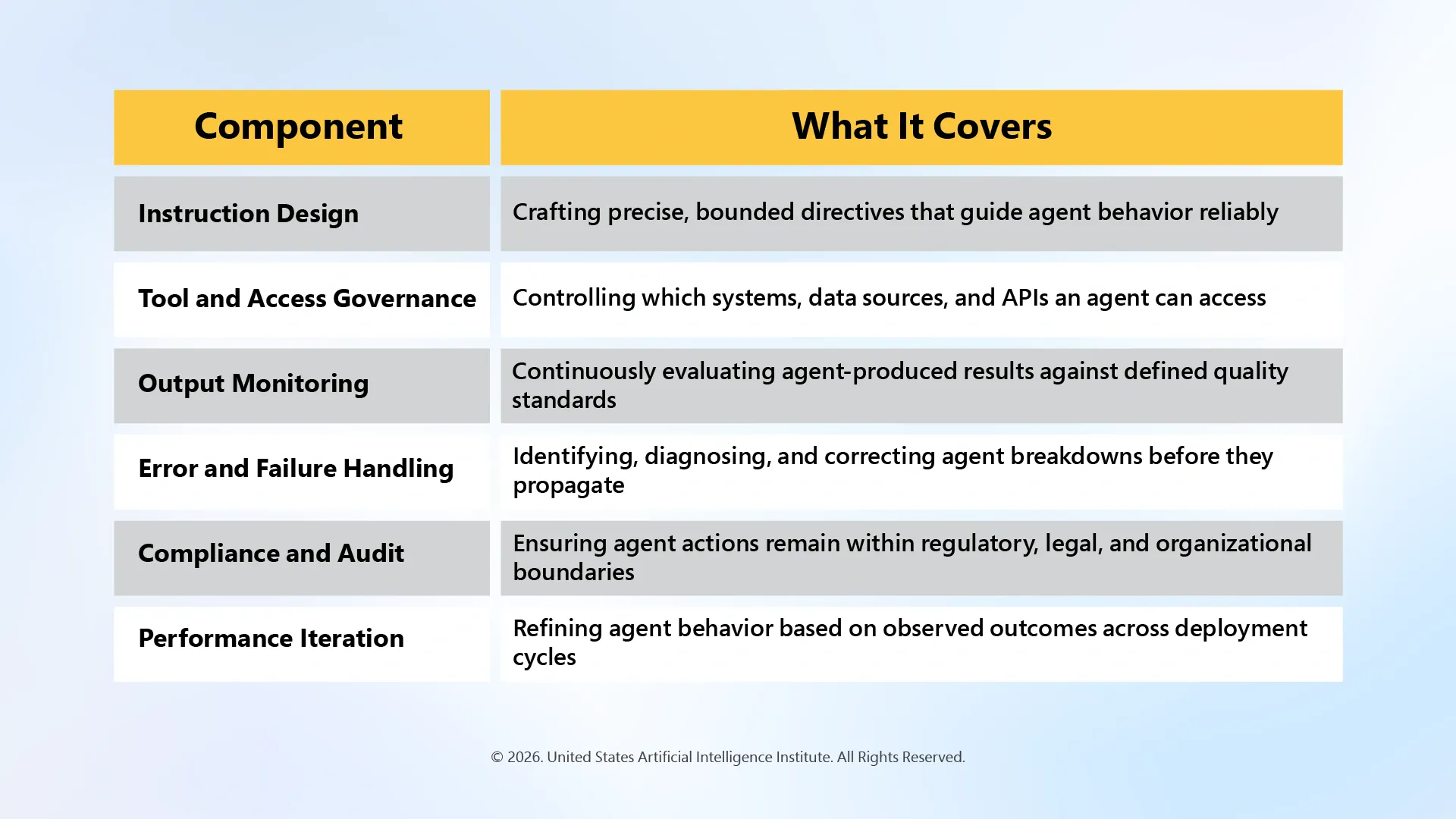
Core Components of AI Agent Management
Why Agent Management Is a Distinct and Non-Negotiable Skill
The critical error many technology professionals make is treating agent management as an extension of general AI literacy or basic prompt engineering. It is neither. AI Agent management for enterprises is a dedicated operational discipline. Consider the specific conditions that make this skill uniquely necessary:
Unlike a single-query AI interaction, deployed agents execute sequences of decisions, tool calls, and sub-tasks without human intervention at each step. A professional who cannot design, scope, and monitor these pipelines is not equipped to work with agents responsibly.
A misconfigured instruction does not produce one wrong output, it produces a chain of wrong outputs, each building on the last, often before any human review occurs. The MIT Sloan Management Review's 2026 AI Governance Briefing identifies silent error propagation in agentic systems as among the top operational risks facing technology organizations this year.
Access to financial records, production codebases, customer data, and communication systems is routinely granted to AI agents in enterprise environments. The professional managing these agents carries governance responsibilities that did not exist in previous technology roles.
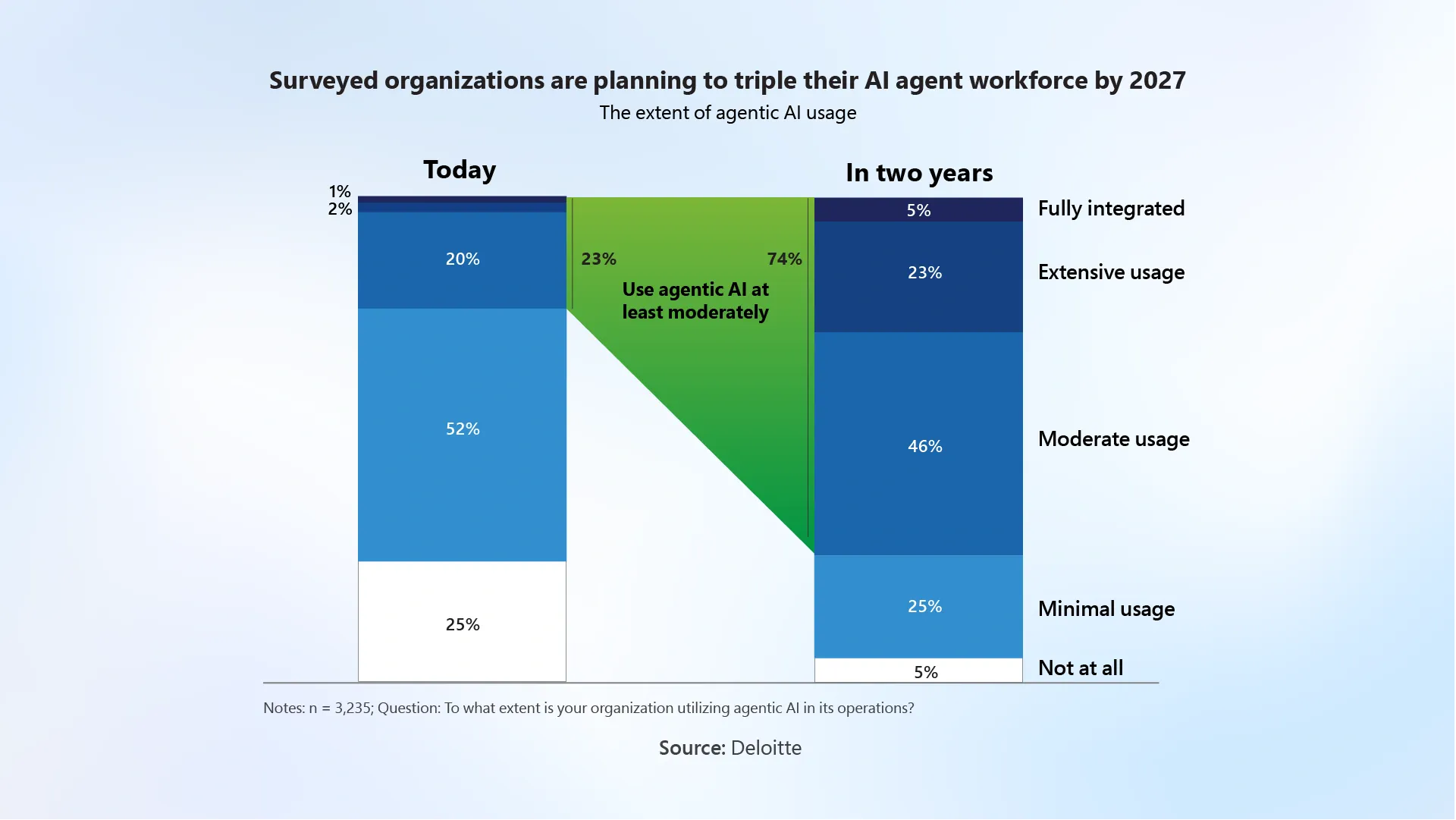
According to Deloitte, while 74% of organizations expect to be using agentic AI at least moderately within two years, only 21% currently have a mature model for agent governance in place. That gap, between the pace of deployment and the readiness to manage it, is precisely where agent management as a professional competency becomes non-negotiable.
What AI Agent Management Requires in Practice
AI Agent management is a structured professional discipline. It is not synonymous with prompt engineering, though prompt design forms one component of it.
The competency encompasses four interconnected areas, each demanding the same rigour applied to any core technical AI skill:
The ability to break a complex objective into discrete, verifiable sub-tasks that an agent can execute with consistency. Agents perform most reliably when instructions are precise, bounded, and logically sequenced. Vague or compound directives produce compounding inaccuracies.
The practice of evaluating agent-produced work against defined quality criteria before any downstream use. Fluency of output must never be equated with accuracy. A systematic verification process is not optional, it is foundational to responsible deployment.
The capacity to identify precisely where an agent breakdown occurred, whether in the instruction, the context provided, the model's reasoning process, or the evaluation criteria applied. Without this diagnostic capability, corrective refinement remains guesswork.
The ongoing adjustment of prompts, context, constraints, and evaluation frameworks based on observed agent behavior across multiple iterations. This is not a one-time configuration exercise. It is a continuous professional responsibility that evolves as both agent capabilities and organizational requirements develop.
A Structured Path to Professional Readiness
Formal preparation remains the most reliable route to developing AI agent management capability with the depth and credibility that career advancement demands. For technology professionals seeking a top machine learning certification in this domain, the USAII® Certified Artificial Intelligence Engineer (CAIE™) offers a rigorous, self-paced program designed to equip professionals with the applied AI engineering skills that 2026 roles require.
Structured across 8 to 10 hours of weekly learning, the CAIE™ provides both the conceptual grounding and practical fluency that responsible agent management demands, making it a directly relevant credential for professionals at this particular career juncture.
The Window for Early Advantage Remains Open
Every significant transition in technology practice creates a brief period in which professionals who invest early in the relevant competency accumulate a disproportionate career advantage.
The emergence of autonomous AI agents as standard operational infrastructure represents the present inflection point. That window will not remain open indefinitely.
The professionals and organizations that act with deliberate intent in 2026 will not simply adapt to what follows. They will be positioned to lead it.
FAQs
Is agent management relevant only to senior or leadership-level technology professionals?
No, it is increasingly expected at mid-level engineering, product, and data roles as agent deployment becomes standard practice across teams of all sizes.
How does agent management differ across industries such as finance, healthcare, and retail?
The core competencies remain consistent, but the governance requirements, compliance obligations, and risk thresholds vary significantly by sector and regulatory environment.
Does agent management require a background in machine learning or AI model development?
No, it is a supervisory and operational discipline that requires understanding of how models behave, not how they are built.