AI is no longer only about chatbots and content creation. It is rapidly turning into autonomous agents, specialized models, and systems that can carry out real work inside business workflows. In 2027, the emphasis will shift toward making the technology a core part of the business, keeping its costs under control, and measuring what it actually delivers.
Gartner’s September 2026 forecast puts worldwide AI spending at roughly $3.64 trillion in 2027, up from $2.67 trillion in 2026. With that much money committed, enterprises will face growing pressure to turn capabilities into tangible outcomes.
The following AI trends 2027 look at the technologies and shifts that will shape how organizations develop, deploy, and govern these systems.
Will Agentic AI Transform How Businesses Operate in 2027?
Agentic AI systems can orchestrate tasks, use tools, and follow multi-step processes with little human oversight. In a Deloitte survey, 74% expect nearly half of their business processes to be redesigned or rebuilt around agents within four years. The same survey shows how far most companies still have to go, since only 5% say their processes are highly prepared for agents.
Scaling these systems will take more than a good model. Permissions, actions, and outcomes must be clear and traceable, and each agent needs testing so its safety and value hold up in production.
Professionals who can develop and manage agents, orchestrate workflows, evaluate results, and apply governance will be the ones building enterprise-ready agentic systems.
How Will Multimodal AI and Generative AI Evolve in 2027?
AI generative tools are transcending text to handle images, audio, and video in addition to text. The global multimodal AI market is expected to expand from a value of $3.0 billion in 2026 to $10.9 billion by 2030, according to Grand View Research.
This progress can help with applications like equipment damage analysis along with technician voice notes and maintenance records.
Multimodal AI integration, output assessment, and hallucination detection skills will assist professionals in creating more trustworthy AI applications.
Why Will AI Reasoning Models and Small Language Models Matter More in 2027?
Complex tasks with multiple steps can be addressed by AI reasoning models, while small language models (SLMs) can be deployed more efficiently with reduced resource usage. A recent IBM study of executives around the world predicted that SLMs would outperform large language models by 2030, with 72% of the respondents saying so.
Companies will be more apt to integrate multiple models to achieve the right mix of performance and cost with privacy in 2027.
Efficient and task-specific AI solutions will be developed by professionals who have mastered model evaluation, RAG, inference optimization, and AI deployment skills.
How Will Physical AI and Humanoid Robots Change Industries in 2027?
Physical AI will be introduced gradually, beginning in environments such as car factories, warehouses, and logistics centers, where the tasks are repetitive and environments are limited. According to a survey released by the Capgemini Research Institute of 1,678 executives, 67% of respondents characterized physical AI as an industry game-changer. Forbes lists Agility Robotics' Digit and Apollo of Apptronik among the humanoids due to come to these destinations, while Tesla's Optimus might appear in 2027.
Physical AI careers are in the intersection of software and the plant floor. Engineers with knowledge of sensor data and safety-critical design will be needed, as well as technicians and operations leaders who can maintain and oversee these machines.
Will AI Infrastructure and Computing Costs Reshape AI Adoption in 2027?
AI is expensive to run, and in 2027 that cost reaches the boardroom. In a Futurum survey of 1,636 enterprise technology decision makers in the second half of 2026, 46.9% said their AI spend is running over budget.
Teams will respond by tracking cost per completed task and dropping services that show no value.
For professionals, this opens a practical entry point. People who can show what a workflow costs and what it returns will be ahead. Budgeting knowledge and plain-language reporting to finance teams will matter alongside technical depth.
How Will AI Security, Governance, and Regulation Evolve in 2027?
Security and governance are moving from policy documents into the systems themselves. Attackers can now push heavy usage through public-facing AI to inflate the bill, a tactic known as a cost exhaustion attack. Europe has also postponed its high-risk AI rules to late 2027.
That leaves companies to govern themselves, and many struggle. A 2026 EY survey of senior AI leaders found that 47% had bypassed their AI governance process for an urgent deployment.
Professional outlook: Employers will look for people who can design AI controls and test them against attack. Judgment, clear communication with executives and legal teams, and ethical reasoning will count as much as technical skill.
How Will AI Transform Enterprise Workflows and Decision-Making in 2027?
AI now produces code, analysis, and insights faster than teams can check them. Gartner expects most new applications to become intentionally disposable by 2029, which raises questions about records, security, and who owns each decision.
Data teams already feel the strain. dbt Labs’ 2026 State of Analytics Engineering Report found that 71% of data practitioners and leaders worry about hallucinated or incorrect data reaching stakeholders. Each workflow needs a validation step, an activity record, and a named owner.
Professional outlook: Demand will grow for professionals who can design these controls, especially in data quality, process design, and AI project and product management.
For a wider view of the emerging AI technologies 2027 will bring, USAII® has ranked the top 10 to watch, including where each is in use and the skills it needs.
How Can AI Professionals Prepare for Technologies Emerging in 2027?
To be ready for the AI trends of 2027, professionals need to understand agentic AI, generative AI, AI infrastructure, responsible AI, and workflow automation, and how each delivers measurable business value as adoption grows.
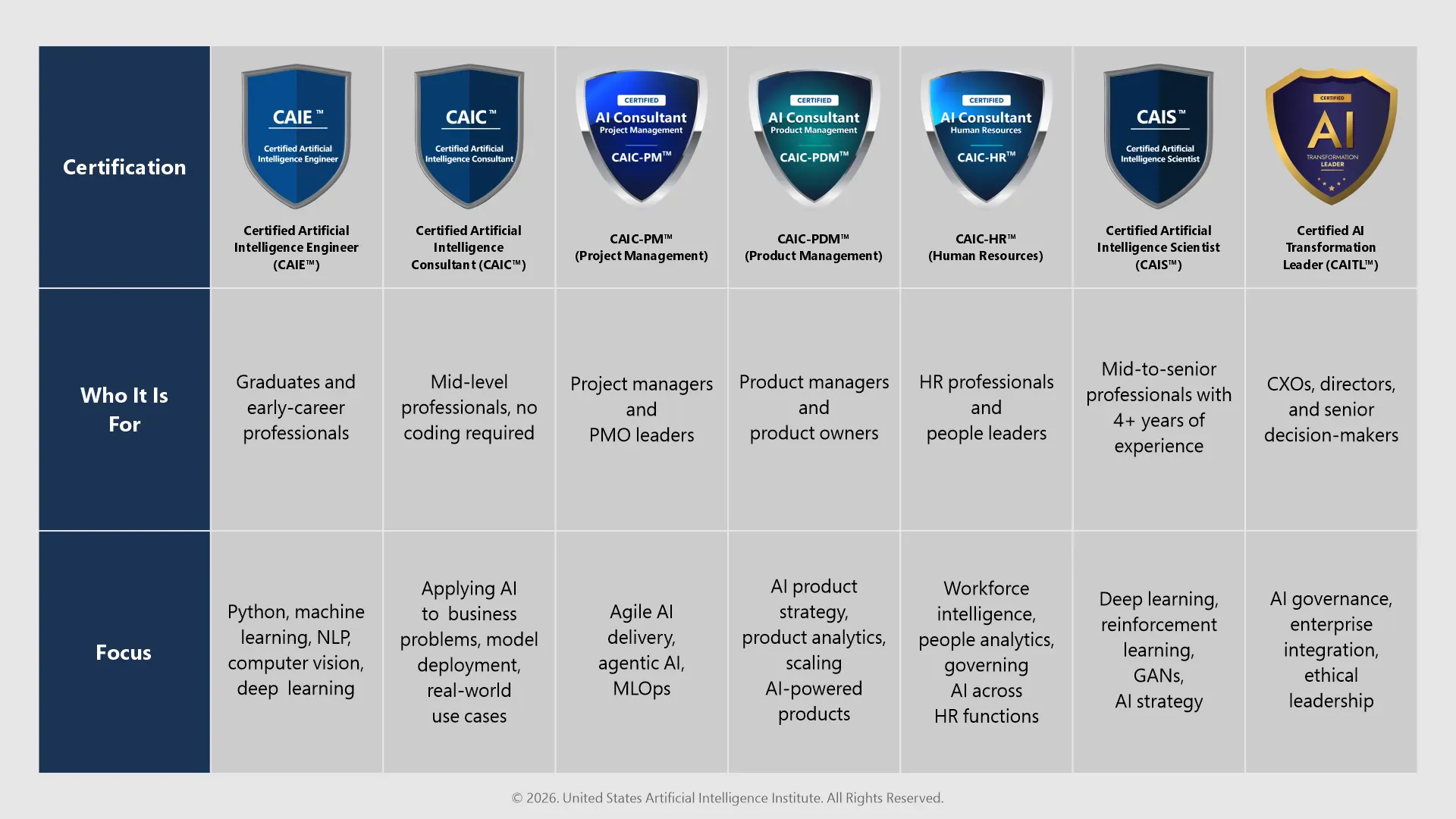
The United States Artificial Intelligence Institute (USAII®) offers AI certification paths for every career stage. Review the options below to find the one that fits your experience and goals.
Also read, USAII® AI Career Factsheet 2027 and Beyond for Professionals it adds the job-market view, including roles gaining momentum, skills employers screen for, and salary benchmarks.
Conclusion
In 2027, AI will be judged by what it costs, how safely it runs, and who answers for it, as much as by what it can do. These Artificial Intelligence trends reward depth over surface knowledge, and professionals who can build, apply, and govern AI will be best placed as AI and ML trends become everyday business decisions.
FAQs
How can a beginner start learning AI in 2027?
Start with Python and basic statistics, then build one small project, such as a simple prediction model or chatbot.
Which industries will adopt agentic AI first in 2027?
Customer service, finance operations, IT support, and software delivery lead, since their tasks follow clear rules and repeat often.
What new roles will AI create in 2027?
Expect more AI governance leads, AI FinOps analysts, agent engineers, and evaluation specialists. Many of these sit between technical and business teams.