By Angela Doyle, Enterprise and Executive Coaching - INOATAR, LLC, United States

Artificial intelligence helps organizations improve the systems they use every day. Digital platforms, databases, workflows, and applications support customer service, operations, decisions, and growth. Over time, these systems can become slow, costly, fragmented, or difficult to manage.
AI system optimization uses data, automation, prediction, and continuous learning to improve efficiency, performance, and business outcomes. The purpose is to make systems faster, smarter, more adaptive, reliable, and useful for the people who depend on them.
Strong optimization begins with a clear business problem and a measurable baseline. Leaders need to understand the current state, define improvement opportunities, set practical targets, and decide where AI can provide value. Responsible oversight must guide each step.
About AI System Optimization
AI system optimization is the ongoing practice of using artificial intelligence to measure, improve, and adapt business and technology systems to enable streamlined efficiency, reducing waste and delays within the pipeline. This approach focuses on measurable outcomes such as speed, reliability, cost efficiency, risk reduction, and business value.
A system may include an IT environment, a supply chain process, a finance operation, a customer service workflow, or a decision-making process. AI can analyze data, identify patterns, predict outcomes, and support action.
Traditional optimization often reacts after problems occur. AI optimization can be more proactive by detecting risks, predicting outcomes, and recommending actions before small issues grow.
For that reason, AI system optimization should be treated as an ongoing business discipline rather than a one-time technical project. The next step is to assess the current state and identify the business opportunities that AI can improve.
Identifying the Current State and AI Opportunity Areas
Organizations should determine where they are today and where they want to be in the future, leveraging AI to meet a business objective. A current-state assessment connects business capabilities, operational pain points, data, user needs, and measurable performance gaps.
A business capability is what an organization must do well to achieve its objectives, such as serving customers, managing inventory, forecasting demand, protecting information, or supporting employees. AI use cases should improve a specific capability rather than follow technology trends.
The current-state review should show where performance falls below expectations, decisions move too slowly, manual effort remains high, risk is increasing, or systems cannot adapt quickly enough. Starting with the current-state assessment gives the organization data to design appropriate AI that aligns with business needs.
This process connects strategy to implementation. A portfolio of case studies can explain the business need and gaps within current infrastructure.
Why Use AI to Optimize Systems?
Several factors are increasing the need for AI system optimization. These drivers show why organizations should connect real business opportunities to real organizational needs, instead of treating AI as a stand-alone initiative.
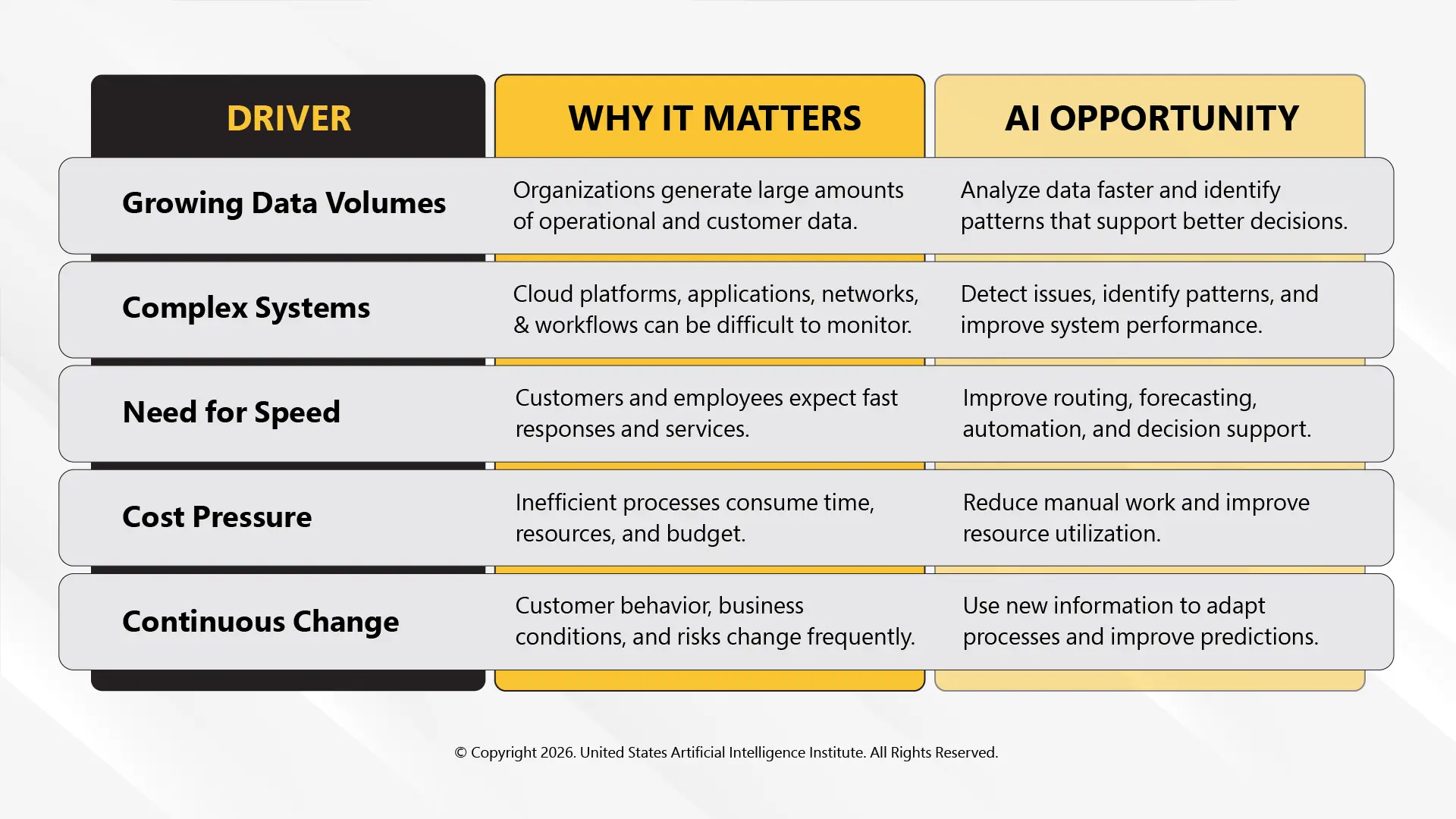
Together, these drivers create the reason for action. Once leaders understand the pressures affecting a system, they can follow a structured journey for assessment, implementation, measurement, and improvement.
Key Steps for AI Optimization
Each driver points to a business problem, such as slow cycle time, rising costs, poor visibility, service delays, or increased risk. By following a structured process, leaders can assess the current state, identify the capability that needs improvement, select the right AI solution, and measure whether the change creates meaningful business value.
1. Assess Current System Performance
Organizations should identify where systems are slow, costly, unreliable, or difficult to manage. The assessment should consider data quality, response time, error rates, user feedback, cost, and business impact.
Metrics such as lead time, cycle time, throughput, error rates, and completion percentage can show where optimization is needed.
2. Identify High-Value Use Cases
AI optimization should focus on areas where measurable improvement is possible. Examples include predictive maintenance, fraud detection, customer service routing, supply chain planning, and IT incident management.
3. Prepare Data and Infrastructure
Reliable data is essential for effective AI optimization. Data should be accurate, current, secure, and accessible. The technology environment should also support integration, monitoring, security, and model performance.
4. Apply the Right AI Capability
Organizations should select the AI capability that best fits the business need. Automation can reduce repetitive work, prediction can help leaders prepare for future conditions, chatbots can improve user support, and AI agents can complete multi-step tasks across systems. The right choice should match the capability gap, available data, risk level, and desired business outcome.
5. Build and Design AI with Security
AI systems should be designed with security, privacy, governance, and responsible use from the beginning. Leaders should define who owns the system, how data will be protected, how outputs will be reviewed, and how risks will be monitored. Secure design helps ensure the AI solution can deliver value while protecting users, data, and business operations.
Common Areas for Business Optimization
The optimization journey gives leaders a repeatable way to move from assessment to action. Once the need, baseline, data environment, and governance approach are clear, leaders can compare common AI optimization areas.
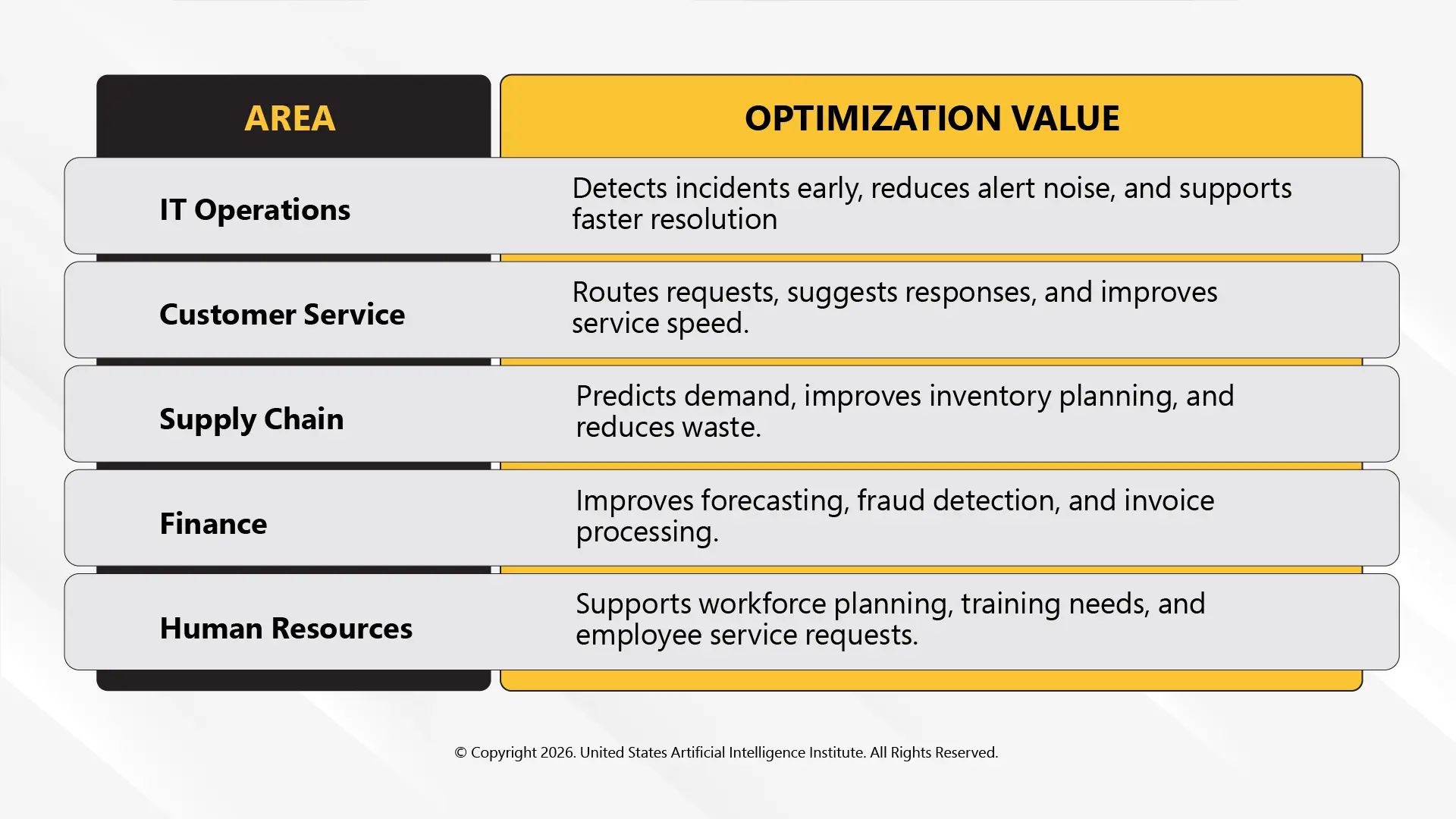
Use cases should reflect organizational priorities. Leaders should weigh value realization, feasibility, risk, data readiness, and measurement. After selecting the pilot areas, the next step is to decide how each AI system will be deployed, monitored, improved, and governed.
Role of MLOps and AIOps
MLOps and AIOps help turn selected AI opportunities into reliable systems. These practices support deployment, monitoring, retraining, performance measurement, and improvement post-deployment.
MLOps supports the machine learning lifecycle through model development, deployment, monitoring, and retraining. AIOps applies AI and machine learning to IT operations by helping teams detect incidents, identify likely causes, and improve system reliability.
These practices help organizations maintain AI systems as data, users, and business conditions change.
Continuous monitoring shows whether an AI system continues to deliver value and helps leaders identify risks before they affect users, operations, or corporate outcomes.
Challenges
AI can create significant benefits, but organizations must manage risks across assessment, deployment, and continuous improvement.
Poor data quality can produce inaccurate recommendations. Over-automation can reduce human visibility. Integration problems can make AI tools difficult to connect with existing platforms and workflows.
Trust is another important challenge. Employees and customers may question AI-supported decisions when the process is unclear. Leadership will need to invest time into establishing appropriate governance, communication, and accountability.
Human oversight remains important when AI influences decisions that affect customers, employees, finances, safety, or other areas of significant business impact.
Effective optimization requires a balance between automation, performance, risk management, governance, and human judgment. Optimization becomes a leadership practice that supports long-term business value realization and corporate growth.
Conclusion
AI system optimization helps organizations improve the performance, reliability, and value of existing business and technology ecosystems. Effective optimization requires reliable data, clear business objectives, governance, skilled teams, and continuous improvement.
The strongest approach begins with a business problem and a measurable baseline. Leaders can then identify the right AI opportunity, implement it responsibly, evaluate results, and improve the system over time.
Organizations that combine AI capabilities with human oversight, responsible governance, and measurable value can build stronger systems for optimizing organizational efficiency for customers and employees.