Project management is always about making choices under uncertainty and constraints like scope, time, budget, and people. AI has not taken away that pressure. What has changed is that more information is available before a decision is made.
PM Solutions 2026 reveals that over 80% of successful companies already implement project management practices that involve AI. This is not a pilot-stage number. In most industries, AI has become a critical tool for planning, tracking, and delivering projects.
It is not the organizations that merely integrated an AI plugin into their existing tools that see real value. They have changed the way project managers spend their time, moving from manual status tracking toward work that involves human judgment: reading stakeholder dynamics, identifying risk early, and making informed tradeoffs. Let us discuss in detail the application, tools, and best practices.
Key Areas Where AI Supports Project Managers
AI's effects tend to concentrate in five specific functions, each addressing a different operational issue.
AI can simulate various scheduling scenarios, taking into account resource availability, task interdependencies, and past delivery trends. It automatically recalculates the critical path in real time when tasks shift, and highlights over-allocation when a resource is working across multiple projects simultaneously, something usually only discovered once a bottleneck hits.
Historical project data can train models that warn of early signs, scope drift, budget overrun, and milestone slippage before they are even discussed at a status meeting. A good tool does not generate a single risk score but instead gives the project manager a ranked list of contributing factors with supporting data to investigate.
Traditionally, a project manager would spend a significant portion of a week creating summary reports for stakeholders from raw project data. With generative AI, this can be done in minutes. Two distinct summaries can be produced from the same dataset without redoing manual work: one as a budget summary for a sponsor and another as a blockers summary for the technical team.
Predictive models calculate the need for future staffing based on the project velocity and historical data so that project managers can plan rather than react when the project is delayed because of staffing shortages. AI can also model the impact of a new project on existing resources that are currently allocated or planned for other projects, thus identifying conflicts months before they actually occur at the portfolio level.
AI can generate meeting notes, action items, and follow-up communications, ensuring consistency of documentation even across multiple fast-moving projects. Some tools now automatically follow up on action items made in a meeting that remain unclosed after several weeks.
Popular AI Tools for Project Management
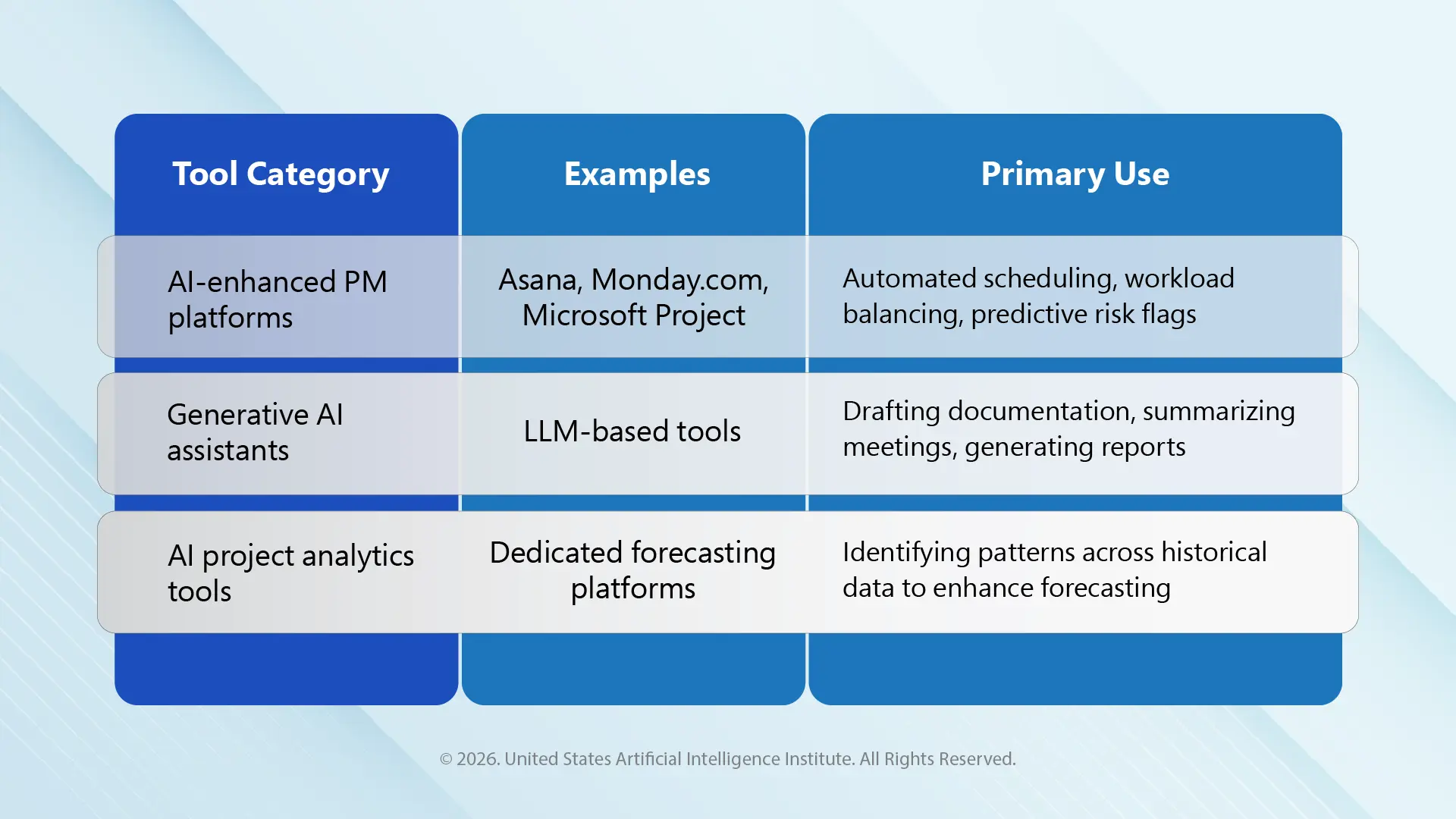
The best combination varies based on team size, project complexity, and existing tools already in place.
Smaller teams can often get much of the value from AI functionality already built into their current project management software, while larger, more complex programs may need a standalone AI analytics tool layered on top. Listed below are top AI PM tools to look for.
Best Practices for Using AI in Project Management
The AI for project management practices below reflect what separates organizations seeing genuine efficiency gains from those adding AI without a clear plan.
Common Pitfalls to Avoid
Several recurring patterns explain why many organizations and teams face challenges when implementing AI in project management. Listed below are common mistakes to avoid.
Upskilling for AI-Driven Project Management
The skill sets required of project managers are changing with the growing presence of AI in everyday project management tasks. Interpreting AI-generated risk flags, validating predictive forecasts, and incorporating AI tools into existing PM frameworks have become practical necessities rather than optional skills.
USAII®'s Certified AI Consultant – Project Management (CAIC-PM™) is designed specifically to equip project managers, PMO leaders, and AI consultants with the practical skills needed for Agile AI delivery, MLOps, AI governance, and enterprise-scale AI project execution. CAIC-PM™ certification program requires no prior coding experience and is designed for professionals looking to shift their careers from traditional project management into AI-focused delivery.
To learn more about whether the certification is the right next step in your AI project management career, see USAII®'s insight on Is CAIC-PM™ the Next Step in Your AI Project Management Career?
Conclusion
AI is not replacing project managers, but it is adding meaningful value to the role. Those seeing genuine benefit from AI, both individually and across their organizations, are the ones treating it as a capability to build deliberately, starting with a clear use case, validating outputs against real project data, and investing in the skills needed to use these tools well. As adoption continues to accelerate across the industry, that deliberate approach will increasingly distinguish high-performing project teams from the rest.
FAQs
Is agentic AI beginning to influence project management?
Yes, autonomous AI agents capable of independently executing routine PM tasks, such as updating trackers or flagging blockers, represent an emerging trend organizations are beginning to pilot.
Which industries are adopting AI in project management most quickly?
Technology, construction, and financial services currently lead adoption, driven by the scale and complexity of their project portfolios.
Are coding skills required to use AI in project management?
No, most AI-enhanced PM platforms and generative AI assistants are designed for non-technical users and require no coding knowledge.