By Christopher Lieu, Director of Global Partnerships & Sales Development - Prescient Security, United States

Right now, the MSPs and vCISOs managing compliance programs on behalf of your clients are working in an information vacuum. Fixing that isn't just a nice-to-have. It's the foundation of a scalable partner model.
Let me describe a situation that plays out dozens of times a week across our partner network.
A vCISO gets a call from one of their clients. The client has a vendor questionnaire on the table. The prospective customer sending it wants to know: are you SOC 2 certified? (SOC 2 isn’t a certification, but I can get into that in another article). Is the audit still valid? Where exactly does your audit stand?
The vCISO doesn't know off the top of their head. The audit is being conducted by Prescient Security. So they send us a message. We look it up. We write back. Two, maybe three hours pass (it could even be more if the partner manager is on leave) before the vCISO can return the call.
That's a small story with a big implication. Multiply it by every partner, every client, every week and you start to see a scalability problem, not just an inconvenience.
Why This Matters More Than It Used To
The compliance services space has changed considerably. Frameworks like SOC 2 and ISO 27001 used to be the territory of large enterprises with dedicated security teams. Now, mid-market and even early-stage companies are routinely required to demonstrate compliance before a sales deal can close.
That shift has created enormous demand for MSPs and consulting firms who can run compliance programs on behalf of companies that don't have the internal expertise to do it themselves.
These partners are doing important, complex work. And they're doing it without a clear window into what's happening with the status of the audit. Especially considering that best practice for a SOC 2 Type II observation period is 12 months.
The Real Cost of Manual Information
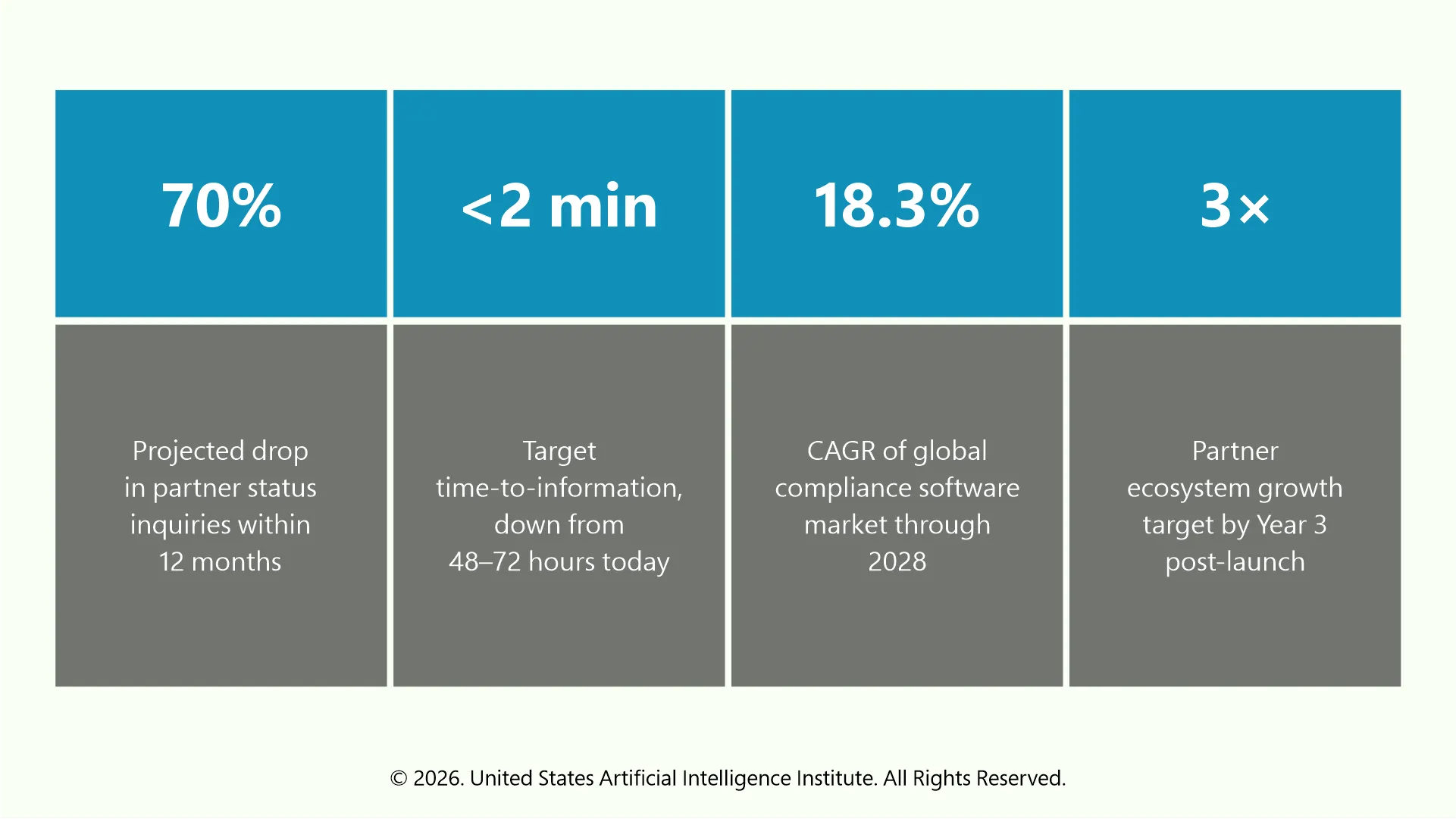
Our internal data tells a clear story. Status-related inquiries such as, "where does this client stand on their audit?" account for somewhere between 60 and 75 percent of the inbound requests our partner managers handle. Not questions about strategy. Not requests for new services. Just, “what's the current state?”
That's not a reflection of partners being disorganized. It's a reflection of a system that gives them no other option. When you can't see something, you have to ask.
The consequences run in both directions. Partners wait hours for answers they should have instantly. Our team spends the bulk of its time functioning as a human lookup tool. Neither side is doing the work they should be doing.
What AI Transformation Actually Means Here
AI transformation, in the broadest sense, is what happens when organizations start embedding AI into the way they fundamentally operate. The goal is more than automation. It's about creating systems that adapt, surface insights, and reduce the friction that slows everyone down.
For our partner ecosystem, that starts with something more basic. Real-time visibility. Before we can layer in predictive intelligence, we need to solve the initial problem. Partners shouldn't have to send an email to learn what's happening with a client they manage.
That's the starting point for what we're building- A Partner Portal.
The Partner Portal: What It Does And Why It'S Different
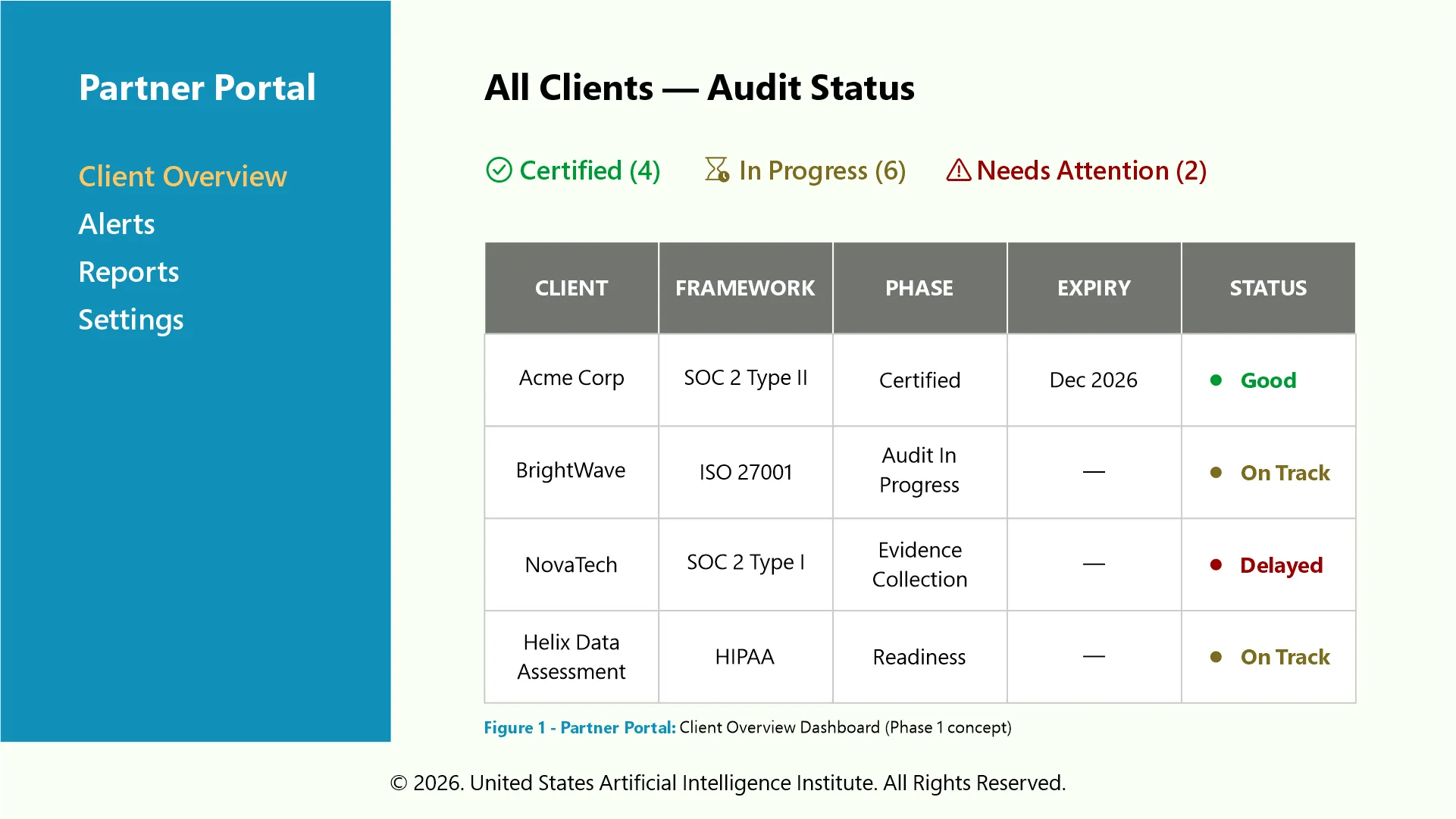
The portal gives every MSP and consulting firm in our network a live view of their entire client book through native integration with our internal tools. They’ll be able to see audit frameworks, current phase, certification expiry, and anything blocking progress.
Partners can drill into any individual client for a more granular breakdown. They can generate on-demand summaries for their own client-facing conversations. Quarterly business reviews, renewal discussions, and vendor questionnaire responses will all be possible with a few clicks of a button.
Here's a rough illustration of what Phase 1 looks like in practice:
On the technical side, we're building this using AI-assisted low-code platforms. These platforms let non-engineering teams design and ship web applications in a fraction of the time traditional development would require. The prototype can be in partners' hands within weeks for pilot user feedback.
Security is non-negotiable, especially for a compliance company. From day one, the portal will enforce role-based access controls. This means each partner firm sees only their own client data. Multi-factor authentication is baked in. The portal connects to our backend through encrypted API integrations, with real-time updates flowing through webhooks.
Three Phase Approach
The roadmap has three phases, and the intelligence compounds as we move through them.
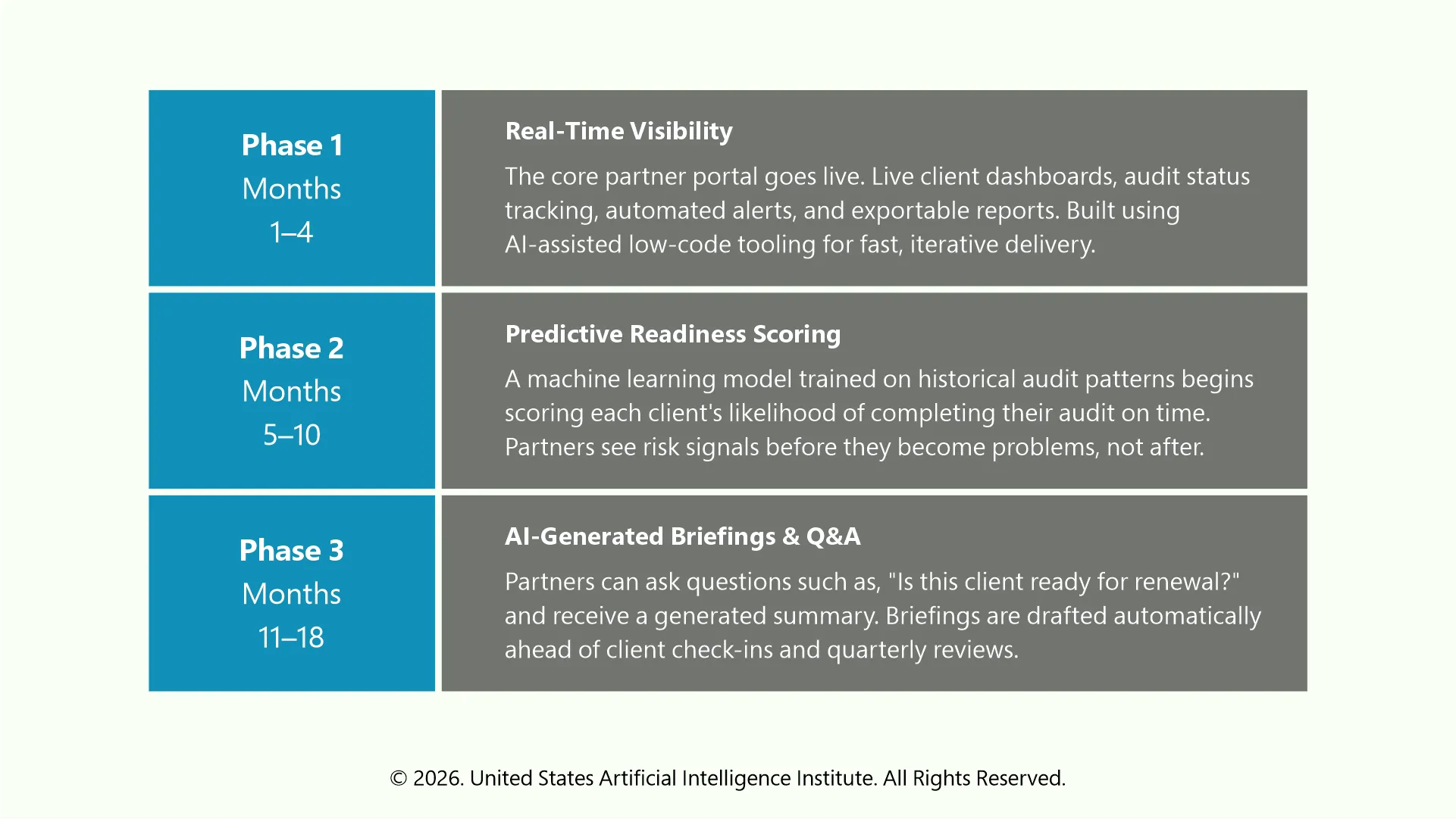
Phase 3 is where the calculus shifts most noticeably. A partner preparing for a client call today has to gather context from multiple sources and decide what's important. Phase 3 removes most of that burden. The preparation happens automatically. The partner shows up informed.
The Long View
There is a version of this project that is framed purely as a cost reduction effort. Fewer emails, less manual back-and-forth, a more efficient team. That framing is accurate, but it undersells what's actually at stake.
The compliance technology market is expanding rapidly. Multiple research firms put the growth trajectory well above 18% annually through the end of the decade. Demand is coming from every direction. Tighter regulations, higher buyer expectations, and more companies reaching the size where compliance is unavoidable.
In that environment, the partners who grow are the ones who can take on more clients without proportionally growing their overhead. A portal that gives them instant access to every client's status isn't just convenient. It's operationally transformative. They can manage a larger book. They can advise more proactively. They can close deals that require demonstrating a client's compliance posture on short notice.
For Prescient Security, the compounding effect is clear. When partners succeed, they grow their client base. When they grow their client base, they bring more business to us. The portal isn't a service feature; it's a growth mechanism disguised as a productivity tool.
There's also something beyond the revenue worth acknowledging. Right now, partners who depend on us for status information experience us as a bottleneck. That's not how any partner should think about a core vendor. Giving them self-service access changes the relationship. We go from being a gatekeeper of information to being an enabler of it. That shift matters for trust, and trust compounds too. And those of us in the industry all know that trust is the epicenter of what we do.
Conclusion
The gap between what our partners need to know and what they can currently access is entirely fixable. It doesn't require reinventing the compliance process. It requires building a front door. A place where partners can walk in, look around, and leave knowing exactly where things stand.
Phase 1 solves the immediate problem: visibility. Phases 2 and 3 take that foundation and turn it into something genuinely unique. A platform that helps partners anticipate problems, not just react to them.
Compliance technology is one of the fastest growing segments in B2B software right now. The window to build something partners actually depend on (and competitors can't easily replicate) is officially open.