OpenAI has released GPT-6 Astra, describing it as the world's most intelligent and aligned model to date. Astra brings together years of research across pre training, reinforcement learning, alignment, and OpenAI positions it as state of the art across computer use, browsing, software engineering, cybersecurity, science, and professional work.
The release stands out less for any single feature and more for the breadth of the jump across categories, with measurable gains in reasoning, coding, and professional task benchmarks compared with GPT-5.6 Sol, OpenAI's previous flagship model. Let us discuss in detail.
From AI Assistance to Autonomous Computer Use
Astra marks a new frontier in computer use, and that shift shows up across several concrete tasks like:
Astra is also better at staying oriented as a task evolves. Earlier models sometimes treated a continuous prompt message as a new goal, losing track of the original request, while Astra incorporates new requirements, changes course when asked, and answers side questions without dropping or deviating the broader task.
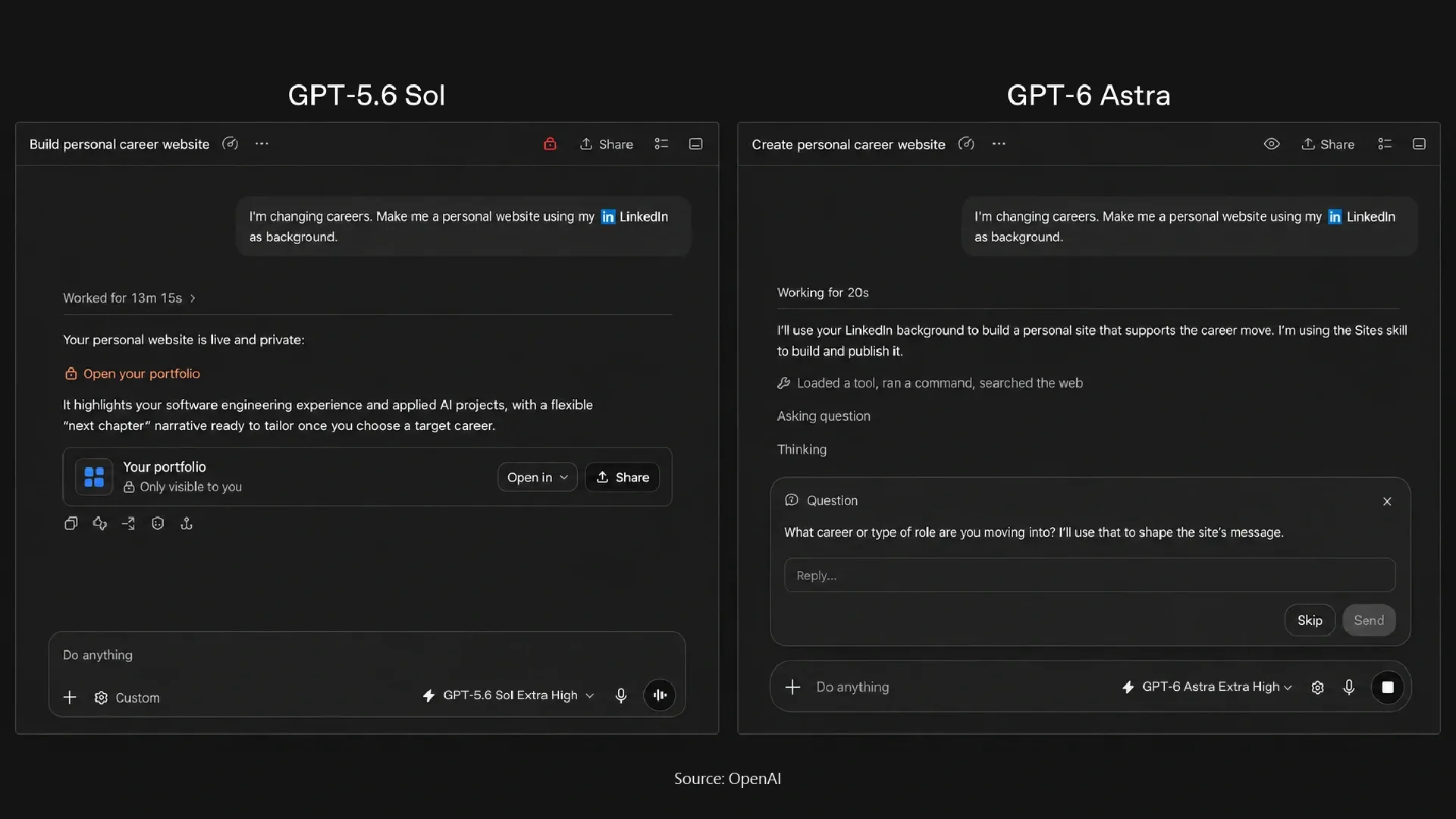
GPT-5.6 Sol builds the site immediately, while GPT-6 Astra pauses to ask what role the person is targeting before building it. That shift changes what AI can be delegated to do, moving it from a tool that answers prompts toward one that can be handed an open ended task and trusted to complete it.
GPT-6 Astra Reaches Human-Level Performance on Novel Tasks
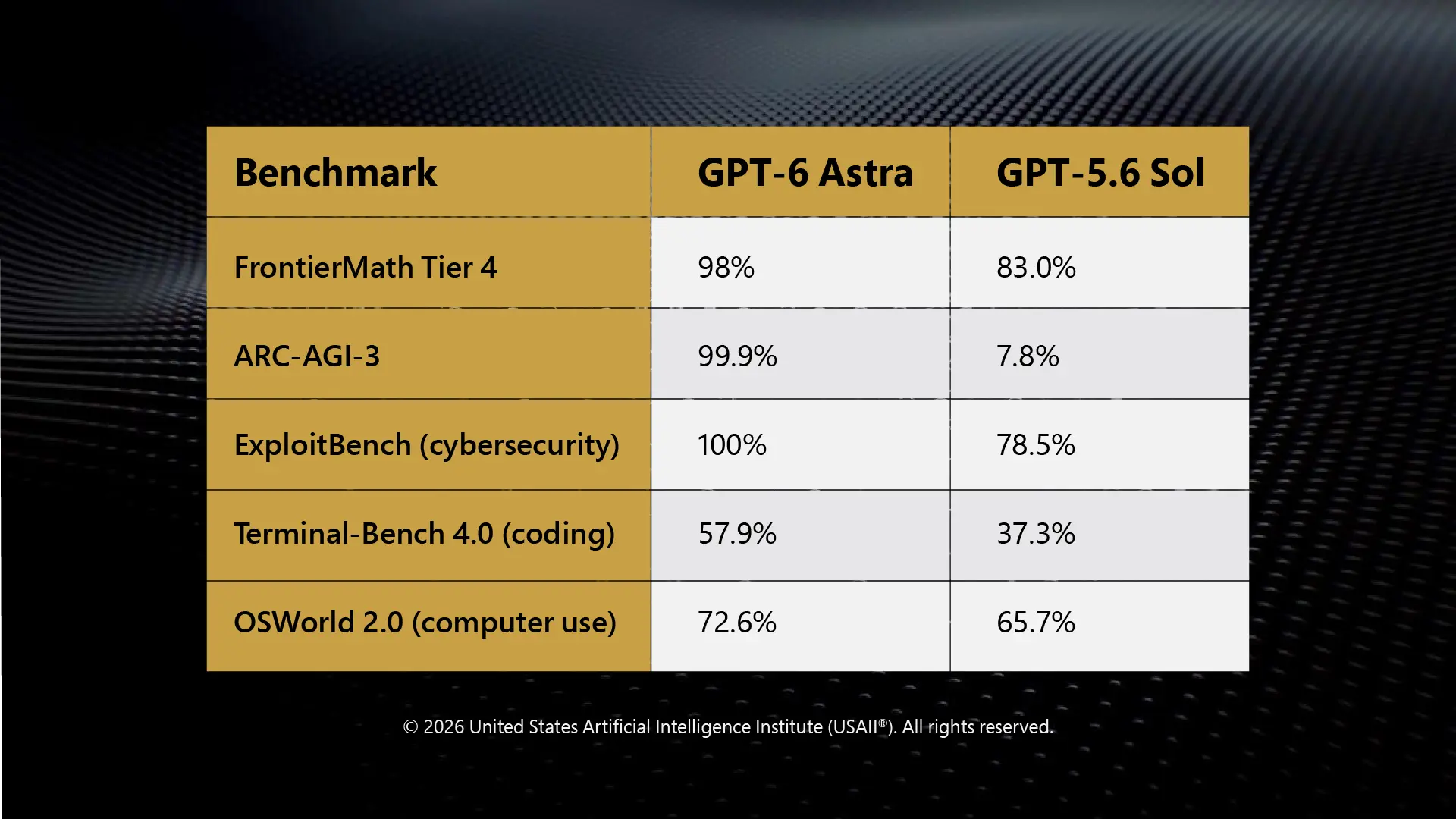
On ARC-AGI-3, a benchmark specifically designed to test reasoning in unfamiliar environments rather than memorized patterns, Astra scored at 99.9%.
"On ARC-AGI-3, Astra surpassed our human action-efficiency baseline on 96% of levels, effectively reaching human parity on the benchmark. Not only is this the best model we've ever tested, but it also represents a meaningful step change in frontier-model performance, not only in its ability to navigate and solve novel environments, but also in how efficiently it learns to do so."
— Greg Kamradt, ARC Prize Foundation
Action efficiency matters here as much as raw accuracy. A model that eventually solves a novel task after excessive trial and error demonstrates something different from one that solves it the way a person would, with comparable steps and comparable learning speed. That distinction is what makes Astra's ARC-AGI-3 result notable; as it focus on generalization to unfamiliar problems, not simply more training data memorized.
From GPT-5.5 Instant to GPT-6 Astra: For context on OpenAI's recent model evolution, read USAII®'s analysis on, "OpenAI Swaps ChatGPT's Core Model: A Closer Look at GPT-5.5 Instant"
What GPT 6 Astra Means for Coding, Science, and Cybersecurity
Astra's gains extend well beyond computer use into three specialized areas that carry distinct implications for professionals working in them:
That cybersecurity capability cuts both ways. It can help defenders identify and patch vulnerabilities faster, but it also raises the bar for the safeguards needed around advanced systems. As frontier models take on more cybersecurity relevant work, the need for professionals with structured, verifiable AI and cybersecurity skills grows correspondingly.
How GPT-6 Astra Could Reshape Professional Work
Astra's ability to execute multistep workflows, produce polished documents and presentations, and run automated research and data analysis reflects a broader shift from prompt-based assistance toward genuine task delegation. As models take on more open-ended work independently, the professionals who benefit most are the ones who understand how to direct, evaluate, and govern that work.
This is where structured upskilling becomes practical rather than optional. USAII® AI certifications provide a structured pathway for building applied AI skill in exactly this direction, giving professionals a way to build judgment around directing and evaluating AI output.
GPT-6 Astra Availability, Performance, and What Comes Next
Astra is rolling out in stages including a limited set of organizations first, followed by ChatGPT Plus, Pro, Business, and Enterprise users, alongside access through the OpenAI API, Microsoft Azure, and AWS Bedrock. API pricing stands at $10 per million input tokens and $50 per million output tokens, with a Fast mode available at twice the speed and price.
The scale of Astra's improvement is visible across its benchmark results relative to GPT-5.6 Sol as listed below.
OpenAI's president has suggested Astra could eventually be viewed as an early step toward artificial general intelligence, though that characterization remains a claim about future significance rather than a demonstrated benchmark results.
Conclusion
GPT-6 Astra represents a broad, measurable jump in capability rather than an incremental update, with gains spanning computer use, reasoning, coding, science, and cybersecurity. Its performance on benchmarks like ARC-AGI 3 points to progress in generalizing to unfamiliar problems, while its staged rollout and pricing reflect a model still being deployed cautiously given its expanded capabilities.
Separating these demonstrated results from broader claims about artificial general intelligence remains essential for understanding what this release changes, and what still lies ahead.
FAQs
Is GPT-6 Astra available to all users immediately?
No. Access rolls out in stages, starting with select organizations before reaching ChatGPT's paid tiers and API customers.
How did GPT-6 Astra perform in real-world testing outside OpenAI?
External partners reported gains directly, including Cognition noting improved output clarity in its Devin coding tool and Harvey observing stronger reasoning on complex legal tasks.
Does GPT-6 Astra replace the need for human oversight in professional work?
No. OpenAI's own alignment testing still requires monitoring and safeguards, particularly for cybersecurity and other high-stakes use cases.