Artificial intelligence is entering a new phase where systems won’t just respond to our commands but will be intelligent enough to plan, reason, and act autonomously. This shift is what we popularly know as Agentic Engineering.
It is not like any other traditional AI development where the focus is on models responding to user prompts. Agentic engineering is focused more on designing and building systems that can act on themselves with proper intent. Of course, a lot of elements are involved behind these autonomous operations, including AI agents.
One thing to note is that though interest in Agentic AI is increasing, only 11% of organizations have deployed such systems in production (Deloitte Report). This clearly highlights the huge gap between experimentation and implementation. Not just that, Gartner predicts that 60% of brands will use Agentic AI for a streamlined one-to-one interaction by 2028, showing the importance of agentic systems in the future.
They have already started transforming industries by offering more adaptive and intelligent workflows. Be it software development, cybersecurity, or healthcare, agentic engineering is redefining how technology interacts with the real world. This article explores what agentic engineering is, its components, applications, why it matters, and more.
What is Agentic Engineering?
Agentic engineering is the practice of designing and building a system of AI agents that can autonomously make decisions, perform tasks, and accomplish any defined goals. They leverage technologies like large language models (LLMs), automation frameworks, generative AI, and intelligent AI agent orchestration to create an adaptive workflow.
At the core, agentic engineering is inspired by the concept of agency, i.e., the ability of a system to act intentionally. In this context, AI agents are capable of:
Agentic AI systems first break complex problems into smaller steps and interact with external tools and systems to perform any task.
AI systems are evolving rapidly, and therefore, the future of intelligent systems will heavily depend on the hardware they are built on. AI engineers must understand neuromorphic computing hardware, an advanced hardware system that will define the future of AI systems. Read ‘Neuromorphic Computing: Is it the Future of AI and AI Hardware’ and explore what the future of AI hardware looks like and how it will affect future AI systems.
Why Do Agentic Engineering Matters?
Lately, agentic engineering is gaining great importance because it is proving very effective against challenges faced by traditional automation and AI systems. Here is why they are important in 2026:
Real-World Applications of Agentic Engineering
Here are a few ways in which organizations can use agentic engineering to boost their operations across various business domains:
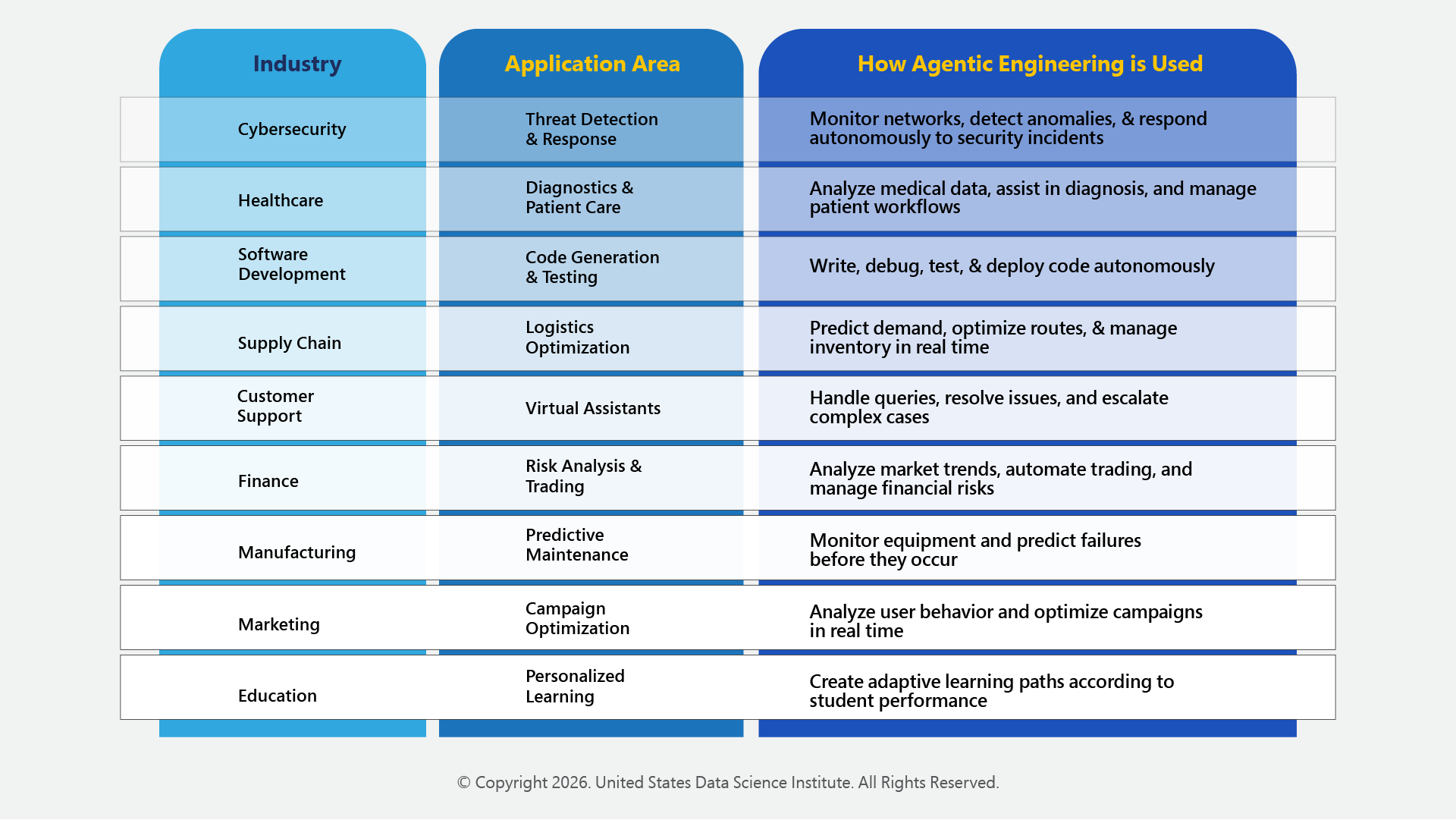
Agentic AI systems are exhibiting a high level of autonomy, and innovations like brain-computer interfaces have a huge influence on how humans interact with machines. Today, technologies like Neuralink are creating a seamless communication channel between the human brain and computers and helping control devices using neural signals alone.
In our latest read, Understanding Neuralink – The Technology Linking Brains and Machines, we understand this groundbreaking technology and how they are bridging biology and AI.
How Can Organizations Adopt Agentic Engineering?
Adopting agentic engineering is not as simple as it sounds, but with a structured approach, organizations can easily adopt these agentic AI systems:
Organizations must first define where they can deploy agentic AI systems that can truly add value, such as in workflow automation or data analysis
The next step is to design efficient systems that support the core elements of agentic AI, i.e., planning, memory, reasoning, and action
Though agentic engineering does not rely heavily on humans as in vibe coding, proper human oversight is important to maintain reliability and ensure safety
Organizations need to define clear policies on how these AI agents will operate. The AI system should also comply with data privacy and security regulations.
The agentic system must also connect seamlessly with APIs, databases, and enterprise tools
Challenges in Implementing Agentic Engineering
Though agentic engineering has huge potential, it also comes with a few challenges that organizations must be considerate of before implementing.
Organizations need to ensure they get consistent and accurate outputs
Autonomous agents that interact with systems can also introduce security risks
Developers should address common ethical AI issues like bias, transparency, accountability, etc.
The cost of building and maintaining agentic systems is also higher and can be resource-intensive for organizations
Organizations should also ensure that agent responses align with human goals.
Organizations should also train their technical teams and developers to gradually move from traditional coding to supervising these AI agents. For this, they may need to learn new AI skills through AI certifications. It is recommended that organizations start with pilot projects first, understand and refine their workflows, and then gradually expand their adoption.
Final Thoughts!
Agentic engineering is a big leap in how developers build software and AI systems. It helps agentic AI systems to act autonomously, learn continuously, and collaborate intelligently, and goes beyond traditional automation to make a fully autonomous system.
Though this concept is still evolving, we can already feel its impact across different industries and applications. Organizations that want to outcompete their competitors have never seen before efficiency and innovation cannot ignore the importance of adopting agentic engineering within their business processes. But they also need to balance the autonomous capability with proper human control for the best result.
With USAII® certifications, professionals can learn how to build responsible agentic AI systems and how to implement them strategically and ethically to reap maximum benefits. Explore the best artificial intelligence certifications based on your career goals and enroll today!