By Vaibhav Dani, Chief Executive Officer - Map Communications, United States

Every industry eventually reaches an inflection point. Continuing to operate as usual becomes the greatest risk of all. For customer service and answering service businesses, that point has arrived. Artificial intelligence is no longer an emerging technology to watch from a distance. It is already reshaping cost structures, customer expectations, and competitive advantage.
Over the past year, my team developed a structured AI transformation plan for the company I lead. The process taught me something important. Successful AI adoption has less to do with the technology itself. It has everything to do with how deliberately an organization chooses to change. This article shares what that journey has taught me, and what I believe it means for the future of business more broadly.
AI transformation is often described as a pure technology upgrade. That framing undersells what is really happening. Businesses across every sector are being asked to rethink how work gets done, how value gets created, and how people and machines collaborate. The companies that get this right will not just cut costs. They will redefine what good service and good business look like.
The AI Imperative: Why This Moment Is Different
For years, service-based businesses grew according to a familiar pattern: more calls meant more people. That model is now changing. Generative and agentic AI are starting to Break the link between volume and headcount, and the evidence is becoming hard to ignore.
Leading telecom and technology companies are already showing what AI can deliver. One global carrier’s AI assistant has handled more than a billion customer interactions across dozens of countries while maintaining strong satisfaction scores. In Europe, a telecom AI system resolved tens of thousands of inquiries in one year, saving the equivalent of a full year of agent work. Another major carrier paired AI with established language models to deliver accurate, always-on support across a wide range of customer needs.
These are not experiments. They are proof that AI-driven customer interaction is mature, scalable, and already changing customer expectations. Companies that treat AI adoption as optional are quietly ceding ground to competitors who are moving faster.
The Anatomy of a Real Transformation
Most companies do not fail at AI because technology is too complex. They fail because they move too quickly without first doing the strategic work. True transformation requires a clear plan, not a disconnected set of pilot projects.
Build, Buy, or Partner
One of the most useful frameworks we applied is deceptively simple. Decide what to build, what to buy, and what to co-develop through partnership. Commodity capabilities, like transcription or basic natural language processing, are rarely worth building from scratch. Proven vendors already do this well and cheaply. Highly regulated or specialized functions, such as healthcare-related triage logic, often benefit from partnerships with vendors who bring compliance expertise to the table. But capabilities tied directly to a company's unique data and client relationships deserve to be built in-house. That is where durable competitive advantage is created.
Data Before Automation
No AI initiative succeeds without a clear data strategy. Before predicting or automating anything, an organization needs to understand its current baseline. That means moving through four stages in sequence: description, diagnosis, prediction, and finally, prescription. Skipping straight to automation without this foundation produces brittle, unreliable results. Data governance is not a side task to revisit later. It is the infrastructure on which the entire transformation is built.
The Human Element: Why Culture Decides AI's Success
Adoption research points to a consistent conclusion that surprises many executives. The biggest barrier to successful AI adoption is rarely technical. It is cultural and organizational.
Leadership sponsorship matters enormously. AI initiatives led from the top, with clear executive accountability, consistently outperform those treated as isolated departmental side projects. Ownership structures can make a measurable difference too. My own company operates under an employee ownership model, which means our people share directly in the outcomes of transformation. That alignment turns AI adoption into a shared goal, rather than a mandate handed down from above.
A hub-and-spoke operating model has also proven effective in practice. A small, central team of AI specialists sets standards, builds core tools, and governs how models are used. Frontline teams then apply those capabilities within their own areas, guided by champions who translate between the technical and operational sides of the business. This structure scales expertise without requiring every employee to become a data scientist overnight.
Governance Is Not Optional
AI transformation introduces new categories of risk. Some are visible, like data breaches or vendor integration failures. These can be managed using familiar tools such as strong contracts, phased rollouts, and existing compliance frameworks.
Others are far less visible. Model bias, credential compromise, and gradual model drift can go undetected for months at a time. They require continuous monitoring, not a one-time fix. A zero-trust security posture, in which every access request is verified regardless of its origin, has become essential rather than optional for any company handling sensitive customer data.
Ethics deserves equal weight in this conversation. Every AI-assisted decision, especially in regulated industries, should include a defined human review step. AI should inform decisions. It should never quietly replace human judgment on anything consequential. Customers and clients should always know when they are interacting with an automated system. Trust, once lost, is expensive to rebuild.
What This Means for the Future of Business
The implications extend well beyond any single company or industry. Three shifts stand out to me as the most consequential for business leaders over the next decade.
First, growth is decoupling from headcount. Businesses that once needed proportional increases in staff to scale can now grow revenue while keeping their teams leaner, redirecting people toward higher-value, more human work.
Second, competitive advantage is shifting toward organizations with disciplined data practices. Companies that treat data as a strategic asset, rather than an operational byproduct, will consistently out-innovate those that do not.
Third, human skills are becoming more valuable, not less. As AI absorbs routine, repeatable tasks, the judgment, empathy, and relationship-building that only people provide become the true differentiator. The future is not humans versus AI. It is humans and AI, each doing what they do best, working side by side.
None of this is unique to answering services or telecom. Retail, healthcare, financial services, and professional services are all running versions of the same playbook right now. The industries and the use cases differ. The underlying pattern does not: assess honestly, choose deliberately between building, buying, and partnering, invest in data before automation, and bring people along rather than leaving them behind.
Conclusion
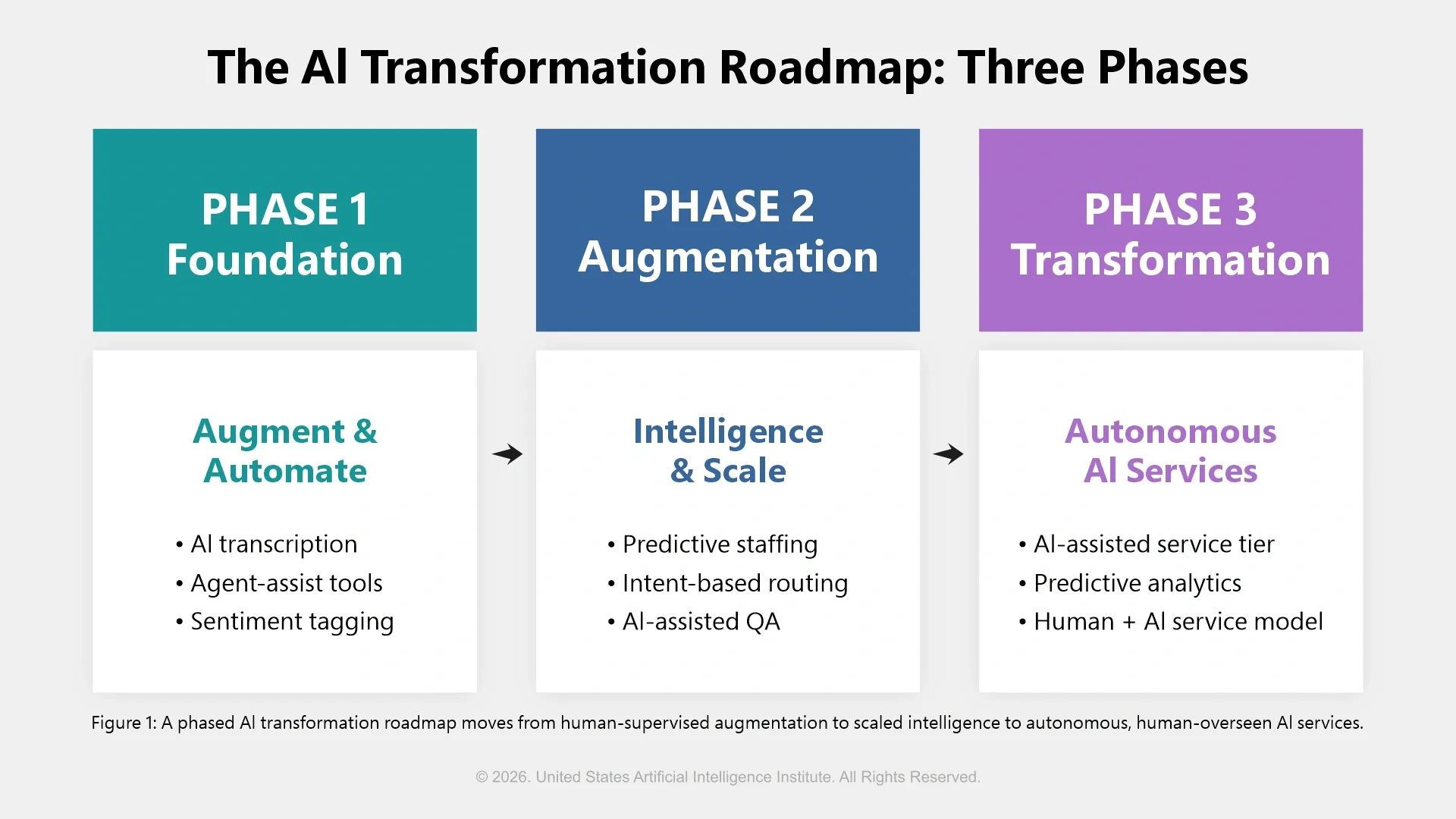
AI transformation is not a single project with a finish line. It is an ongoing capability that organizations must build deliberately, phase by phase, with as much attention to people and governance as to technology.
I believe the businesses that lead this transition, rather than follow it, will define the standards their industries operate by for the next decade. That is the opportunity before every leader today. The question is no longer whether to adopt AI. It is how deliberately and how responsibly we choose to do it.